

Dear planetary friends:
Today I have the privilege of introducing you to an excellent artist, a woman whom I deeply admire, not only for her career, but also for the humanity that resides within her. I am referring to the visual artist María Elcy Ramírez Cuartas, born on July 24, 1954, in the municipality of Sevilla, Valle del Cauca, Colombia.
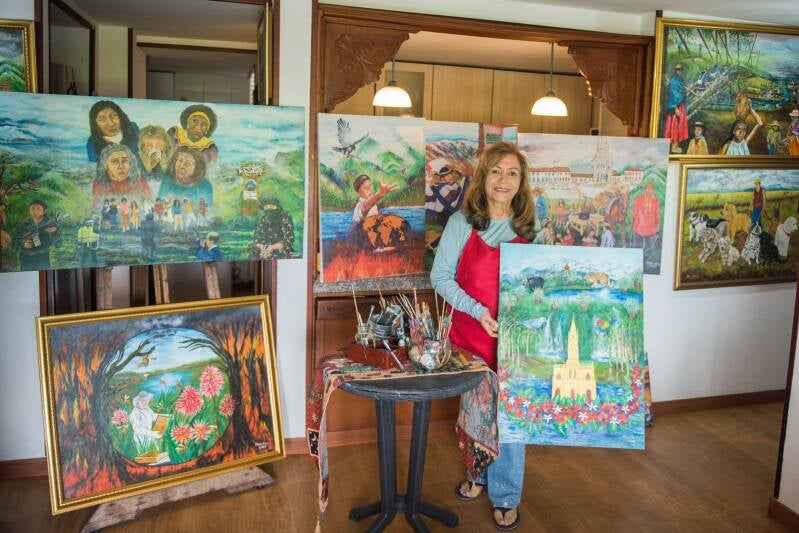
María Elcy Ramírez Cuartas, a Colombian visual artist, poses in a corner of her studio, surrounded by her paintings and brushes, with a colorful smile. Photo/Courtesy.
She recalls her origins and the environment in which she grew up: “My parents were Miguel Antonio Ramírez Guarín, a tiller of mountain dreams and a coffee grower by profession, and my mother, Estefanía Cuartas Gallego, a seamstress by trade; while she worked, she sang and wrote poetry. That was where my inspiration was born: in a warm, peaceful, and loving environment where dignified and hardworking hands taught me the value of honest work. Sevilla, my native homeland, allowed me to experience adolescence between the neighborhood and rural life, in San Antonio.”
Growing up and living in a rural environment will always be inspiring, even more so for those devoted to art. Our interviewee adds: “Growing up among coffee landscapes, sunsets and sunrises that only Sevilla possesses; enjoying the customs and daily life of my farming community shaped my soul and my artistic project. My work sings to nature to thank God for the gift of creation, and to my descendants, whom I represent through five little birds dancing amid the landscapes. This profound and spiritual connection with the landscape becomes melody, praise, prayer: an act of love and gratitude that is the greatest gift to the senses. I use it as the background for the main scene in my works, which focus on paying tribute to the trades of the past that refuse to disappear. Trades that made history, civilization, and idiosyncrasy; ways of being and thinking imbued with art and tradition that constituted the deepest roots of peoples and their identity.”
Interview:
What lasting memories do you keep of your hometown, Sevilla, in the Department of Valle del Cauca?
It is impossible to forget those places where we loved life so deeply. There, the family was united: my father, Miguel Antonio, a farmer, a tiller of dreams, who cared for the little piece of land to provide us with sustenance.
I remember my mother as loving and responsible, supporting my father and taking care of the home while practicing her profession as a seamstress. In that simple and peaceful family environment, one could breathe the freshness of Sevilla’s climate: the mist caressing the coffee-covered mountains, the greenery of the blooming crops, the music, and the noble farmers carrying out their work.
How old were you when you discovered your vocation for the visual arts?
I do not know how or when my vocation for painting began... I can only say that I have always been accompanied by a deep sensitivity to the beauty of color, its harmony in nature, and the joy I felt from experiencing so closely, on my father’s farm, the singing of birds, the smell of ripe guava, the aroma of freshly roasted coffee, and my farming community caring for the land with so much love. Those pure feelings became an inner desire, a spark of emotions that somehow I had to express; from a very young age, I began to paint.
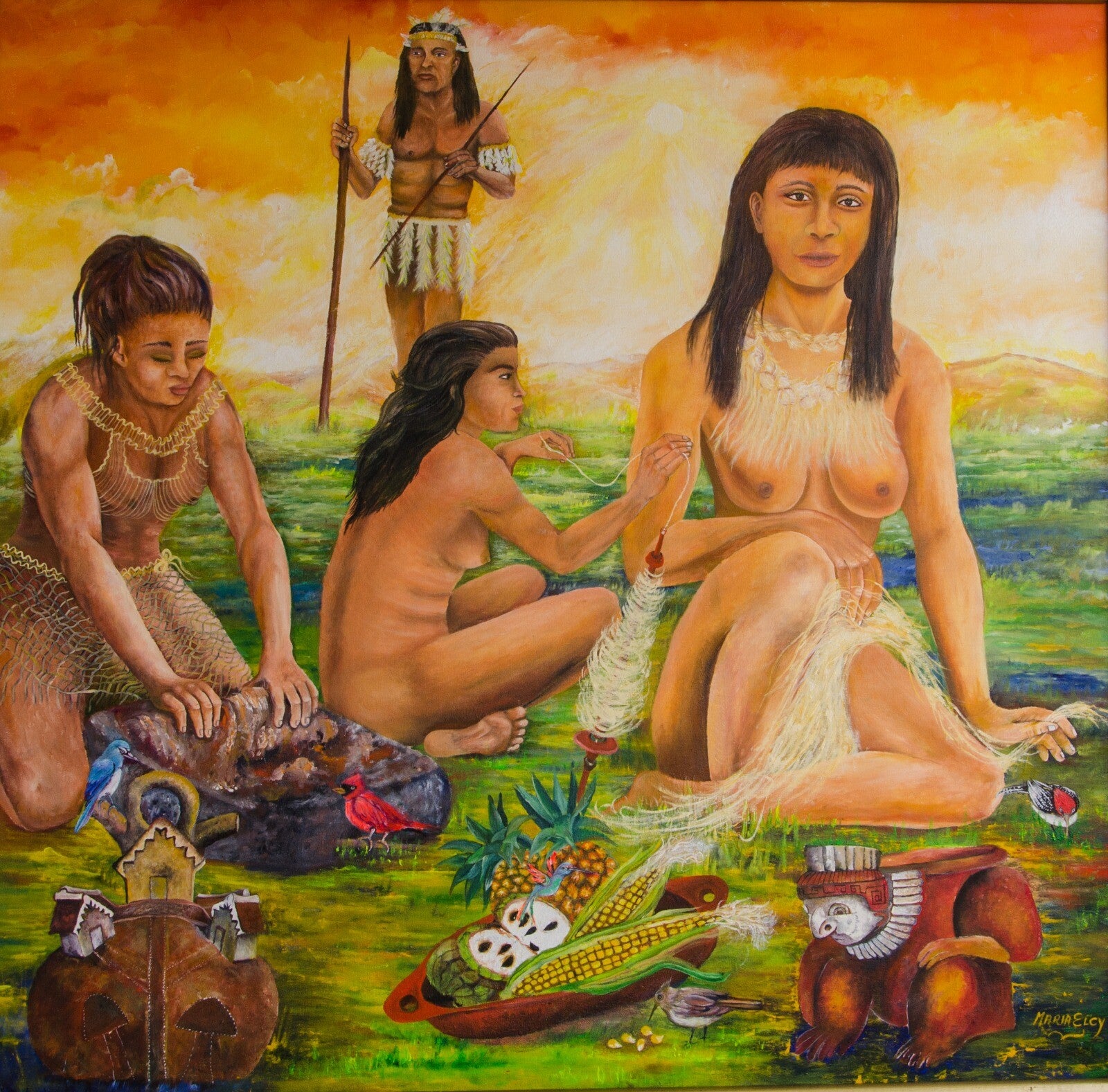
Title: Life in Her Hands. Technique: Oil on canvas. Dimensions: 99 × 96 cm.
Artist: María Elcy Ramirez Cuartas. Courtesy.
What lasting memories do you keep of your hometown, Sevilla, in the Department of Valle del Cauca?
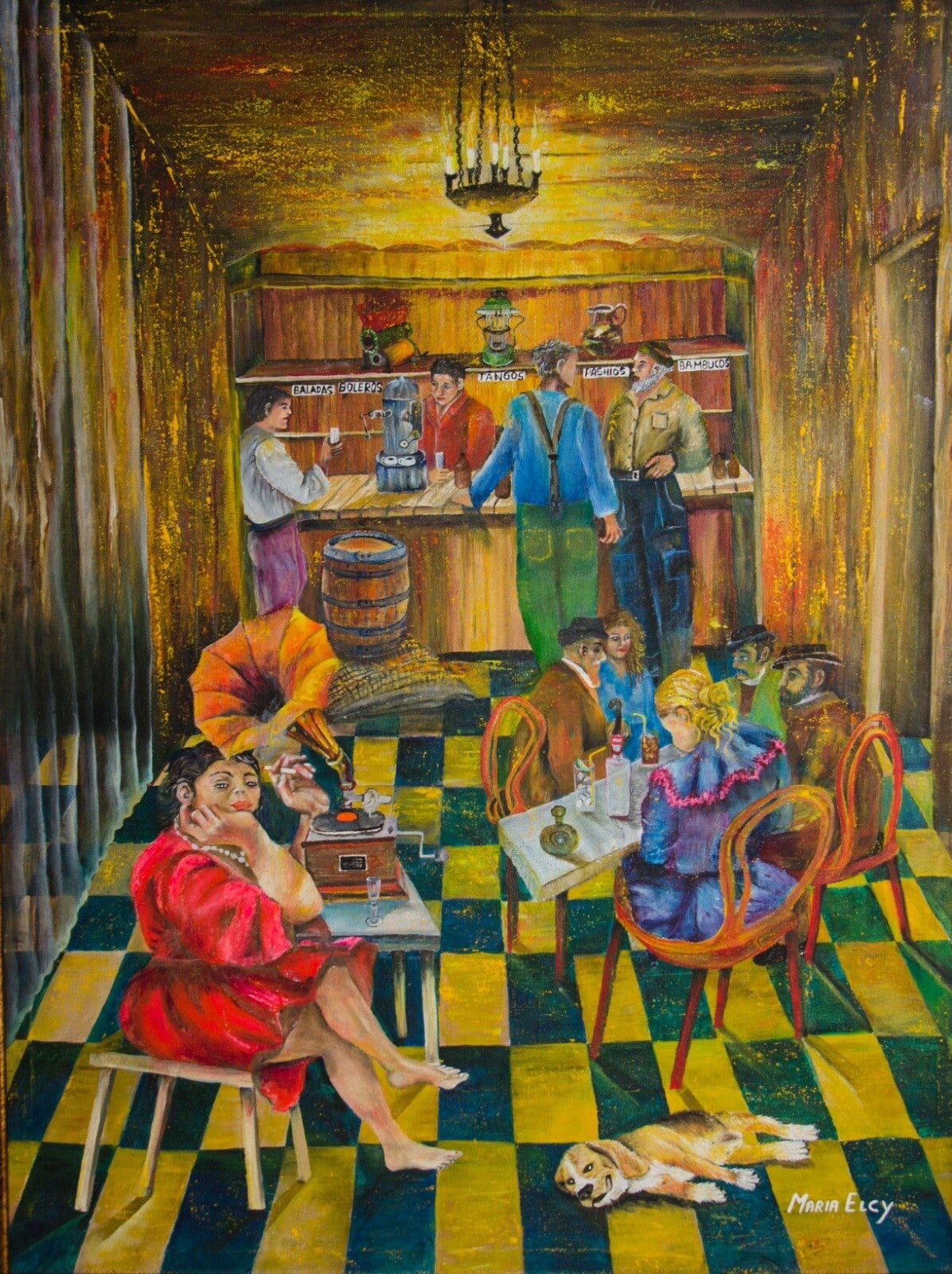
Title: Tribute to the Tavern Keeper. Technique: Oil on canvas. Dimensions: 84 × 65 cm.
Artist: María Elcy Ramirez Cuartas.
It is impossible to forget those places where we loved life so deeply. There, the family was united: my father, Miguel Antonio, a farmer, a tiller of dreams, who cared for the little piece of land to provide us with sustenance.
I remember my mother as loving and responsible, supporting my father and taking care of the home while practicing her profession as a seamstress. In that simple and peaceful family environment, one could breathe the freshness of Sevilla’s climate: the mist caressing the coffee-covered mountains, the greenery of the blooming crops, the music, and the noble farmers carrying out their work.
How did growing up among colorful and natural landscapes like those of your hometown influence your work?
I can proudly say that Sevilla was declared by UNESCO part of the “Coffee Cultural Landscape of Colombia, World Heritage Site” in June 2011. Sevilla is also the “Coffee Capital of Colombia.”
I feel that this relationship with the land, its generous biodiversity, the pure air, the average temperature of 20 degrees Celsius, the simple life, the dignity and wisdom of my farmers, and so much natural beauty made the landscape a recurring element in my work and a dreamlike light for my senses. Returning to the simplicity of nature and its harmony is what inspires me the most.
Your mother was passionate about music and poetry. What did she think of your first artistic works?
She was tremendously moved. She was also a seamstress, a human being full of nobility and tenderness, with such genuine sensitivity that, without realizing it, she became the inspiration for her children. Her unconditional love, patience, and wisdom strengthened our dreams, and that is how each of her four children began to achieve their goals.
My older brother, when he was young, ventured into theater; he is also a poet and an outstanding cultural promoter. My sister Amanda is a music lover. Aldemar is a writer and poet, with an emphasis on Zen poetry.
What does your artistic project, “Homage to the Trades of the Past That Refuse to Disappear,” consist of?
My artistic project is poetic, simple, and human, where the protagonists are artisans: people who work with their hands, minds, and hearts to give us unique pieces of art.
From our farmers, I exalt their resilience in keeping biodiversity alive, caring for the environment, and preventing ancestral knowledge from disappearing in food culture, water conservation, and simple planting techniques, shaping the future of food through every seed and every tree they plant.
In general, it pays tribute to traditional trades of the past that still persist today with difficulty, resisting the automation of modern life. Trades that made history, identity, and a spirit of struggle, forming part of our collective memory; they are the threads that wove the social fabric of our communities.
Let us remember the potter: their silky hands not only shaped objects, but also the earth itself.
The stone mason, with loving strength, tamed stone and today stands as a testament to ancient architecture.
And so many other trades: the shoemaker, the carpenter, the seamstress... faithful examples of ingenuity, patience, and strength.
The color green frequently appears in your works. What is the reason behind this chromatic choice?
I love color in all its expression; in reality, it is what organizes my ideas. The color green, especially because it is the most vibrant and a symbol of pure life in nature, conveys balance, freshness, calm, and serenity. I also conceive of it as an act of resistance, with the hope and longing for new fruits from the earth.
I feel a very strong spiritual connection with nature; observing it in silence allows me to feel the presence of God in so much beauty and the profound peace it conveys to me: watching a sunrise, the sun rising in the east, the setting of the evening sun, a little flower blooming in my garden, the singing of birds.
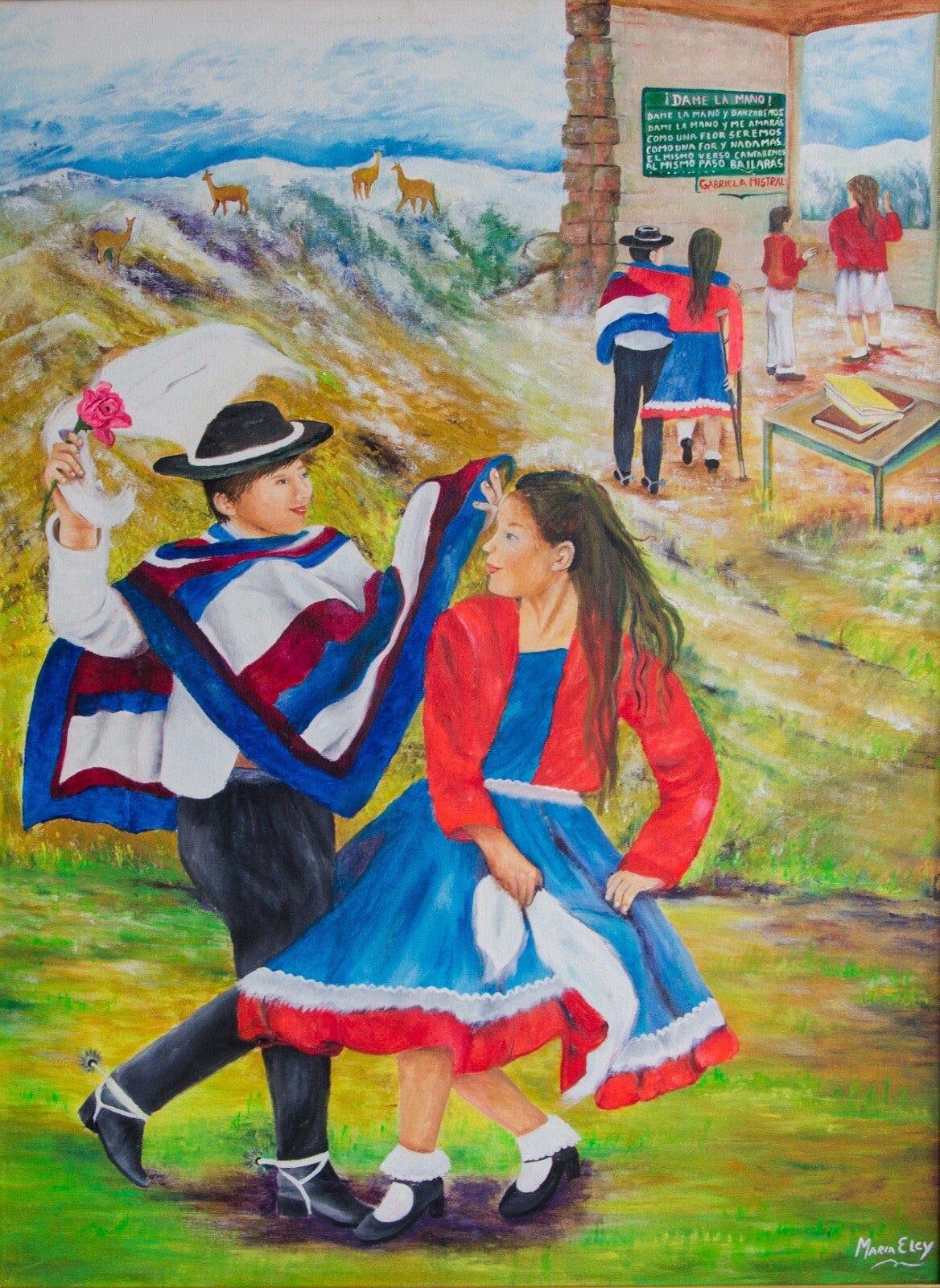
Title: Give Me Your Hand. Technique: Oil on canvas. Dimensions: 81 × 60cm. Year: 2022.
Artist: María Elcy Ramirez Cuartas.
Thus, the landscapes in my work become melody and prayer, a praise to God, our Father, as an act of love and gratitude for the beauty of creation, which is the greatest gift to our senses. In these landscapes, I also represent my descendants through five little birds.
Elcy’s artistic style is costumbrista and figurative, and it addresses diverse themes, highlighting social issues and Mother Nature. Through these lines, I would like to extend my sincere congratulations to Mrs. María Elcy for her valuable work. I invite you to learn more about this South American artist, whose artistic work is undoubtedly brilliant. It is a true honor to be able to share this interview with you, dear readers. In this pleasant conversation, we discuss her influences and the themes she explores, and at the end, she shares a reflection and a message directed at young people who aspire to become visual artists.
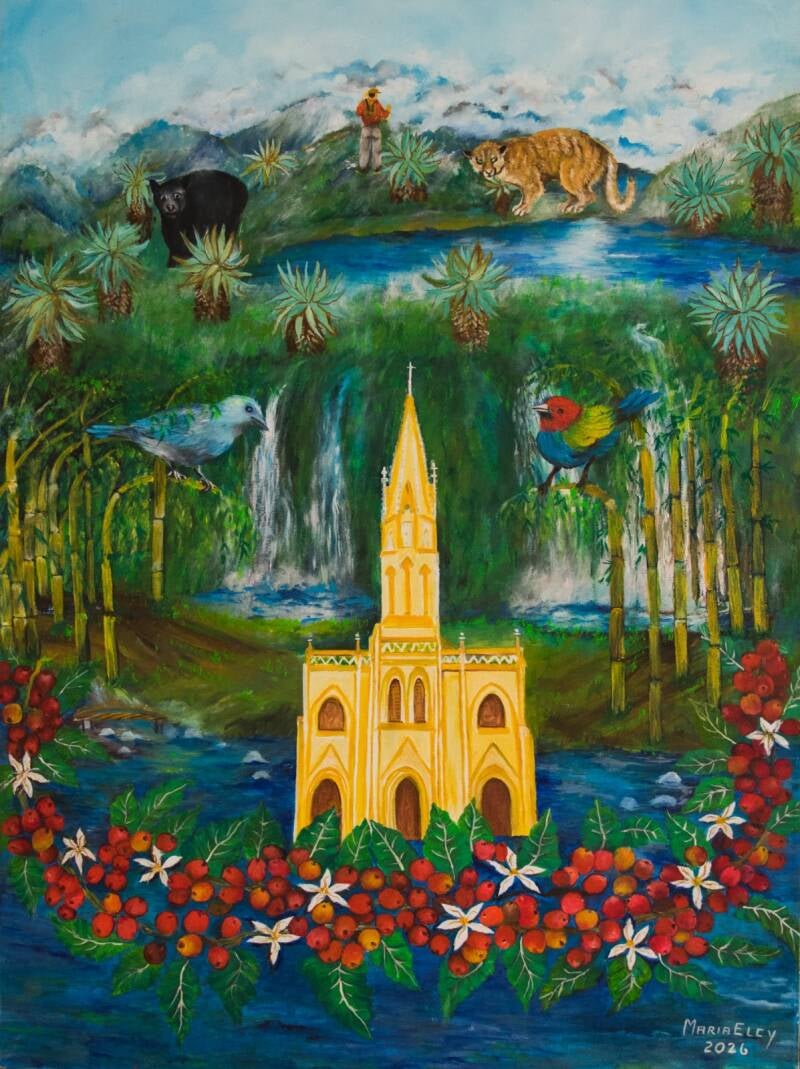
Title: Seville, Water Planet. Technique: Oil on canvas. Dimensions: 75 × 55 cm. Year: 2026. Artist: María Elcy Ramirez Cuartas.
What are the main themes you address in your work?
My work expresses memories and experiences that touched my sensitivity from a very young age; I try to address feelings of gratitude and admiration toward farmers and toward everyone who carries out a trade with their hands.
I also address ecological issues, making an urgent call to care for the environment and using the aesthetics of art as a tool to raise awareness about the effects of global warming, which disrupts the balance of our Mother Earth: home, human refuge, and shelter for ecosystems and species that are fundamental to the development of life. Water is a vital resource for existence.
Nor have I remained indifferent to the dehumanization of war, forced displacement, and the suffering of mothers and children who are victims of armed conflict in Colombia and around the world; I leave a record for memory as a cry of solidarity, resistance, and denunciation, questioning social silence and the absurdity of war.
As a self-taught artist, have you faced rejection from other artists?
Personally, I have not felt any rejection. But it is good to remember the rejection women have suffered throughout history and the silent struggles of brave women who took to the streets to demand justice, at a time when they could not even attend university, much less participate in politics, hold public office, or express themselves fearlessly as artists.
Here in Colombia, after many struggles, women exercised their right to vote in 1957. For centuries, many women artists were rendered invisible in the history of art because they were irreverent and daring; many years—even centuries—later, we can speak of them in order to rewrite history.
Not far from here, we have the Colombian artist Débora Arango (1907–2005), a pioneer of Expressionism, recognized for portraying the social marginalization of her time; she painted nudes, prostitutes, and events related to the Colombian violence she lived through. That is why her work carries such weight: she showed that political reality in a raw and unvarnished way.
She caused so much discomfort that her works were often removed from exhibitions in Colombia and Madrid. Her recognition came late; today, she is established as the most important female painter in the history of Colombian art, a symbol of rebellion and critical talent.
Which artists do you consider to have influenced your work?
Ricardo Gómez Campuzano (1891–1981), from Bogotá, recognized as the singer of the Colombian landscape. He was educated in Spain and was influenced by Sorolla and Dalí, developing his work between the Impressionist avant-garde and traditional landscape painting.
Jean-François Millet (1814–1875), a 19th-century Realist painter and the son of farmers; his realistic painting with socialist touches, which portrayed the innocence of the rural man, inspired great artists. I also greatly admire Vincent van Gogh and Claude Monet.
What does exhibiting your work in public spaces and in different cities mean to you?
For many years, I painted for pleasure, and the idea of exhibiting my work did not concern me, but my friends constantly encouraged me. From one moment to the next, many national and international invitations began to arise, and virtually, I have received valuable recognition that has allowed me to gauge how different cultures and art critics react in each space.
In my in-person exhibitions, I love witnessing that silent dialogue between the work hanging on the wall and the gaze of the public, their gestures of astonishment and reflection. It moves me to feel it as a reward for my work; that is what nourishes the artist and encourages them to continue with the enthusiasm and passion that characterize them.
What message would you like to share with young people who are beginning their journey in the visual arts?
I would tell them that art is a kind of catharsis and personal expression: that they should paint what moves them, what makes them happy, or what hurts them. That they should paint freely and, above all, honestly. That passion and love are our most important driving force, accompanied by constant observation and the loss of the fear of making mistakes.
I would also tell them that the beauty of our landscapes and nature is the most complete teacher we have, and it is permanently within our reach. By observing it, we learn about composition, color harmony, textures, light, and shadow. And in the process, we give thanks to God for the gift of creation.
The interviewer is a Nicaraguan writer based in Costa Rica.

Add comment
Comments