

By Carlos Javier Jarquín
There are people who know how to make remarkable use of their time, to such an extent that they inspire admiration or even envy. They know how to divide their time, make the most of it, and thus develop their talents and take them to a very high level compared with the majority. A majority that, unfortunately, does not always develop this ability to cultivate its own capacities with notable success.
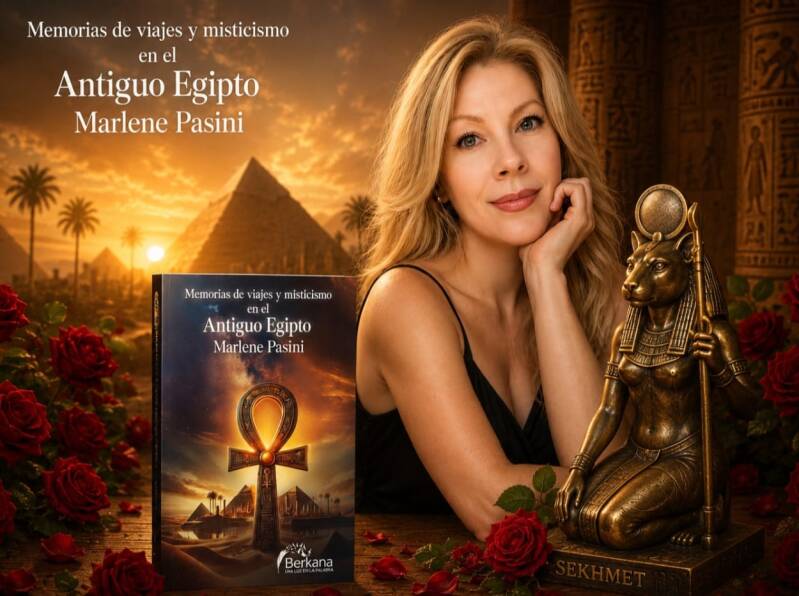
Marlene Pasini’s most recent book is Memorias de viajes y misticismo en el Antiguo Egipto, a work that she will officially present this September in Cairo, Egypt. Photo: Courtesy of Marlene Pasini.
Today I have the pleasure of sharing with you an interview I conducted with the Mexican artist Marlene Pasini. She is a poet, writer, editor, visual artist, compiler, cultural manager, and psychotherapist, whose work has developed across poetry, essays, novels, and spiritual reflection. In addition to her work as a creator, she is a communications specialist, an expert in alternative medicine, holds a master's degree in Hispanic American Literature, and has studied History, Egyptology, hieroglyphics, comparative religions, and mysticism. Her literary and artistic work possesses that magical universal quality that makes her a multifaceted artist worthy of authentic and genuine admiration.
Our guest is a woman overflowing with talent, charisma, beauty, and, above all, humanity. Throughout her life, she has created an admirable legacy, both through her literary work and her artistic work. She is the author of 20 books of poetry, novels, essays, and articles, and she has also held countless art exhibitions, both virtual and in person. Marlene is co-author of the anthology CANTO PLANETARIO: HERMANDAD EN LA TIERRA, Volumen I, (H.C EDITORES, 2023).
In the following link, Marlene reads a poem of her own authorship, taken from Canto Planetario: https://youtu.be/bc1i0Hmy2u4?si=zKr26VH1rOC9Yxfb
In this interview, she tells us about her latest published book, titled Memorias de viajes y misticismo en el Antiguo Egipto, a work she will officially present during this month of September in Cairo, Egypt. She also talks about how she divides her time as a homemaker, as a mother, as an artist, and, of course, how she makes time for her companion animals.
Likewise, from her perspective, she shares her thoughts on how to know how to invest one's time on social media and how to make the most of these platforms, which for many become a dependency and, for others, even a kind of digital slavery.
She also speaks about her passions: art, knowledge, travel, and, of course, her books. As a tireless traveler, she has written several works inspired by her journeys through different regions of the world. She shares with us the main message she conveys—or aspires to convey—through her paintings. And, to close, she leaves us with a message to the world from Mexico: a message of peace, hope, and love; a profound invitation to reflection, as only she knows how to do from her diverse and colorful world.
Interview
What moment or experience from your childhood had the greatest impact on you?
Many moments in my life have been special, moments that, as happens in this world, bring both joy and sadness, but all of them have helped me develop a process of personal work oriented toward spirituality.
Since I was a child, I had a strong inclination toward writing and reading, especially books related to mysticism and human development. History and ancient cultures have also always been my great passions. I believe that this curiosity and search for knowledge that were present since my childhood were laying the foundations for what would later become my career as a writer, poet, artist, and student of ancient wisdom.
What motivated you to study history, Egyptology, hieroglyphics, comparative religions, and mysticism?
I was always an inquisitive woman, eager for knowledge and for seeking to learn about the history of the great civilizations that have left an important mark on humanity. So, from an early age, I felt a particular inclination toward Ancient Egypt. Over the years, and after studying two university degrees—Communications Sciences and Transpersonal Psychotherapy—I completed a master's degree in Hispanic American Literature and a postgraduate diploma in Renaissance History. Later, after traveling to Egypt for the first time in 2017, I felt the need to write a book about it, and it was from that point onward that I decided to formalize my studies in Egyptology, also incorporating the study of hieroglyphics.
Your most recent work is titled Memorias de viajes y misticismo en el Antiguo Egipto. Can you tell us about this book?
Precisely after studying Egyptology and having visited Egypt on three occasions, I became interested in leaving my own mark within this fascinating field. Knowing that there are many books about Ancient Egypt, I wanted to do something different, somewhere between the historical, the esoteric, and the mystical, integrating my own personal experience during my travels through Egypt, not as a tourist, but as a priestess of time.
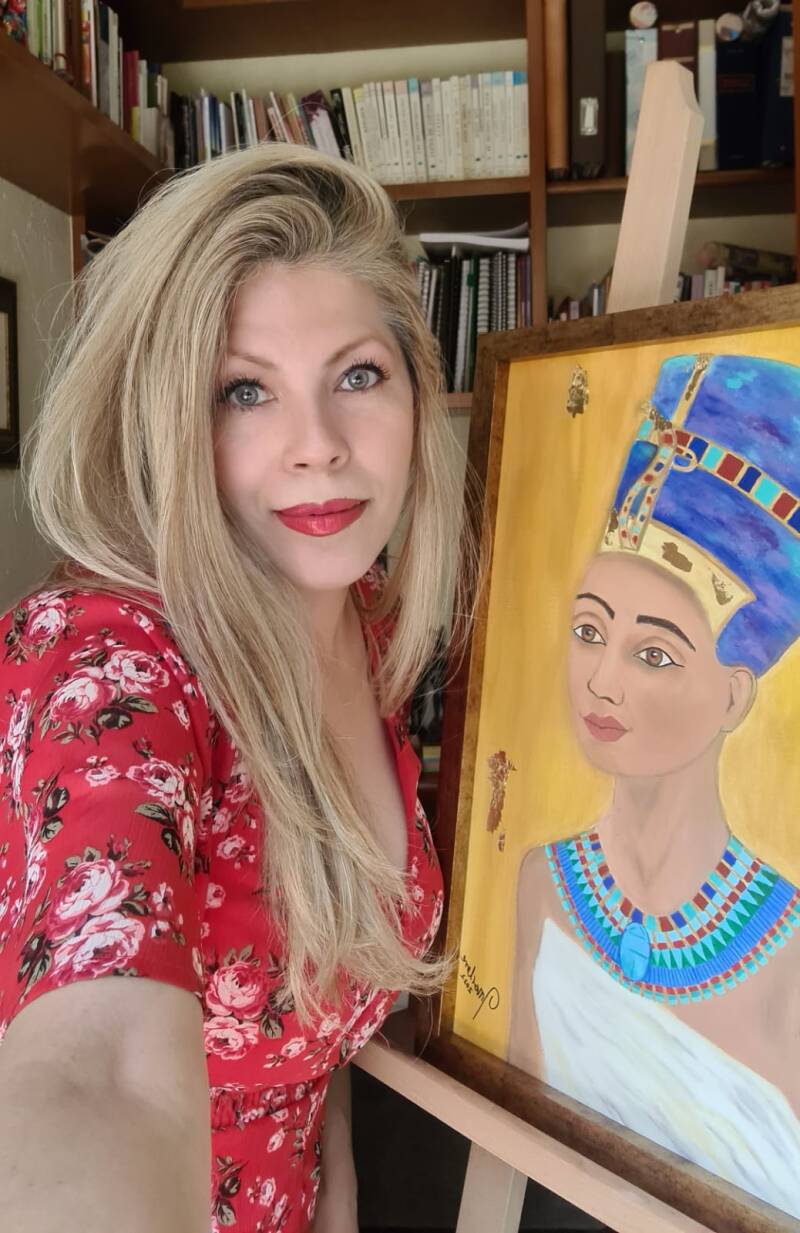
Marlene Pasini poses alongside one of her paintings. Photo: Courtesy of Marlene Pasini.
The book has finally been published, and I feel profoundly happy because during this month of September, I will have the opportunity to formally present it in Egypt, in that land that, without a doubt, has opened a deeply meaningful horizon within my career as a writer, poet, artist, psychotherapist, and Egyptologist.
What did it mean to you that the foreword to this work was written by Dr. Hussein Bassir, director of the Museum of Antiquities of the Library of Alexandria?
I had the opportunity to meet Dr. Hussein Bassir several years ago. From our very first meeting, he became interested in the work I had been developing throughout my career as a writer and poet. In 2019, he invited me to present my poetry book Claroscuro, translated into Arabic by my official translator in Egypt, Dr. Raghda Maged, and reviewed by the Hispanist professor Abdellah Aghzaf, from Morocco. The presentation took place in the library of the Museum of Antiquities of the Library of Alexandria, which was an extremely important event in my literary career.
Considering, moreover, that Dr. Hussein Bassir is an eminent Egyptologist, I decided to invite him to write the foreword to my book, Memorias de viajes y misticismo en el Antiguo Egipto. For me, having a figure of his importance accept to become part of this project represents an enormous honor and has a very special meaning within my career. In addition, the book also includes a review by Dr. Tarek El Khouly, a prominent Egyptian politician who has served as a parliamentarian in Cairo. All of this gives the work very significant support. The participation of these personalities gives the book special relevance and represents, for me, a very important moment in my journey as a writer.
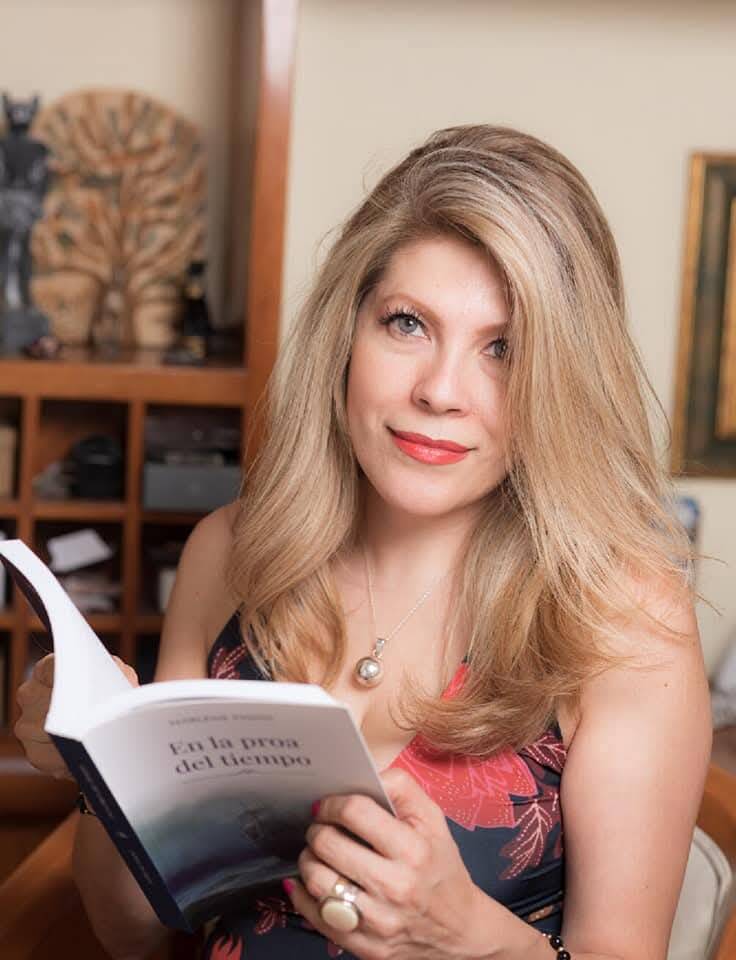
Marlene is a tireless traveler who has written several works inspired by her journeys through different regions of the world. Photo: Courtesy of Marlene Pasini.
What does it mean to you that this is your first book published as an Egyptologist and that you will present it in Cairo?
Definitely, for any writer or Egyptologist who has dedicated a work to the study of Ancient Egypt, having the opportunity to present their book in Cairo represents something of incalculable importance. For me, it means recognition of my career, not only as an Egyptologist, but also as a writer.
This opportunity has been possible thanks to the coordination and support of Dr. Taghrid Fayyad, president of the Fayyad Egypt-Lebanon Cultural Forum, who has also honored me for several years by appointing me cultural advisor to this institution.
The Forum carries out important work promoting literature and culture through gatherings, literary events, and poetry readings, and for me it has been very meaningful to perform my role there as cultural advisor. Therefore, presenting my first book as an Egyptologist in Cairo has enormous significance within my literary and cultural career. I am bringing a work that was born from years of study, research, experience, and personal experiences.
You have traveled to several countries, and these journeys have been a source of inspiration for writing some of your works. Could you tell us briefly about them?
Fortunately, life has given me the opportunity to travel to different countries, and some of those journeys have become a very important source of inspiration for my work. I am interested in travel literature not only from the experience of a tourist discovering new places, but from a deeper perspective that leaves invaluable testimony.
From my travels through the Middle East and North Africa, including Morocco, Tunisia, the Holy Land, and Egypt, came my book Memorias nómadas del Medio Oriente al norte de África. Other countries have also formed part of that creative background. Spain gave rise to my haiku book.
Memorias de Andalucía. I am currently also working on a new book of poetry that will bring together poems and haikus inspired by several of the countries I have visited over the years. It will be a poetic journey through different geographies and the experiences those places have left within me.
What is the central theme of your book El lenguaje secreto de las almas: Berkana una luz en la palabra 2023?
This book is part of my poetry collection, which currently consists of nine of my twenty books, and it was born from a moment in which I experienced a profound connection with sacred aspects and a special intimacy with my own soul.
I feel that El lenguaje secreto de las almas was a revelation. That which the soul can perceive, express, or reveal beyond conventional words.
With these poems, I had experiences of spiritual connection that could be interpreted as encounters with beings of light, with other souls, or even with God. They are experiences that came to me and found in poetry a form of expression.
The book was also born at a historical moment that many people perceive as particularly complex, even with an almost apocalyptic feeling.
For this reason, I consider it a powerful poetry collection, not only because of its poetic content, but because it addresses human concerns from a perspective of mystical and sacred revelation.
There is a spiritual search within it that evokes the visionary experience, as it was for many mystics.
Given your interest in cultivating various artistic disciplines, what does knowledge mean to you?
Rather than talking about knowledge, I would speak of wisdom, because there is a difference between accumulating knowledge and truly attaining wisdom.
Knowledge can be acquired through books, study, and academic experience. Wisdom, on the other hand, implies a much deeper understanding of life and the human being. It is also a legacy that we receive from the great ancient cultures of the world.
Could you tell us about your work as a specialist in alternative medicine?
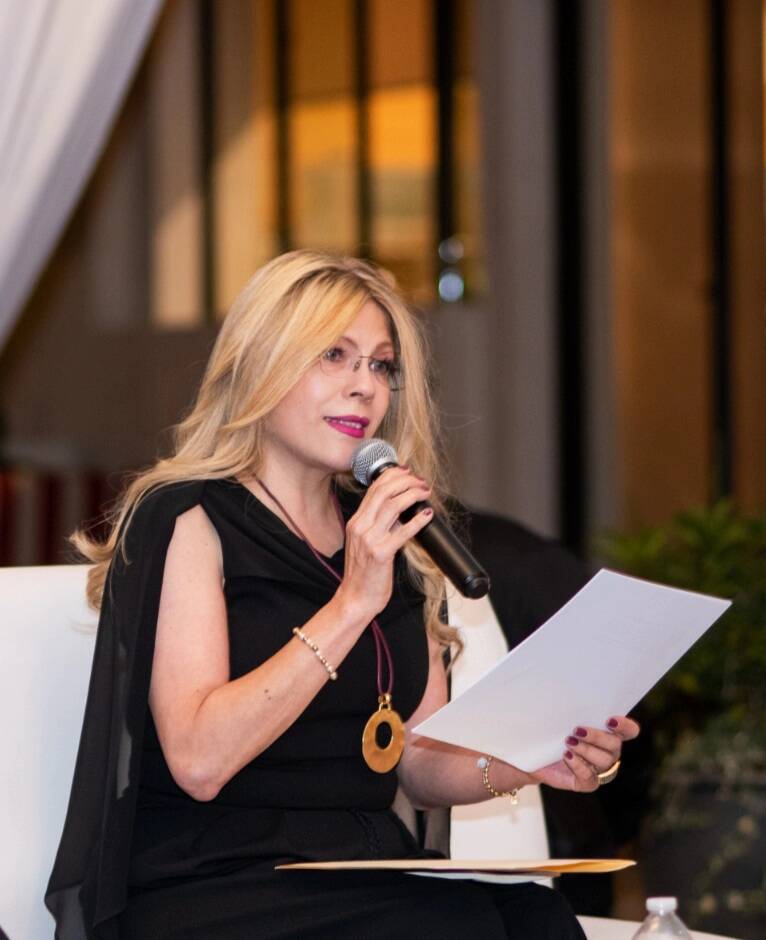
Marlene Pasini is a tireless traveler who has written several works inspired by her journeys through different regions of the world. Photo: Courtesy of Marlene Pasini.
The second university degree I studied was Transpersonal Psychotherapy, with a specialization in Education. For several years, I treated patients in private practice, and I felt the need to complement my training with different tools related to alternative medicine.
I believe that these disciplines can offer complementary resources for approaching the human being from an integral perspective, taking into account not only their psychological dimension, but also their emotions, inner world, and spiritual dimension.
Throughout that process, I trained in different tools, including flower therapy, sound therapy with Tibetan singing bowls, the Lakota medicine wheel, pendulum work, and dowsing, among others. All of this has been important both professionally and in my own process of personal development. Currently, although I am no longer practicing, this knowledge and these experiences are a complementary part of my literary and artistic career.
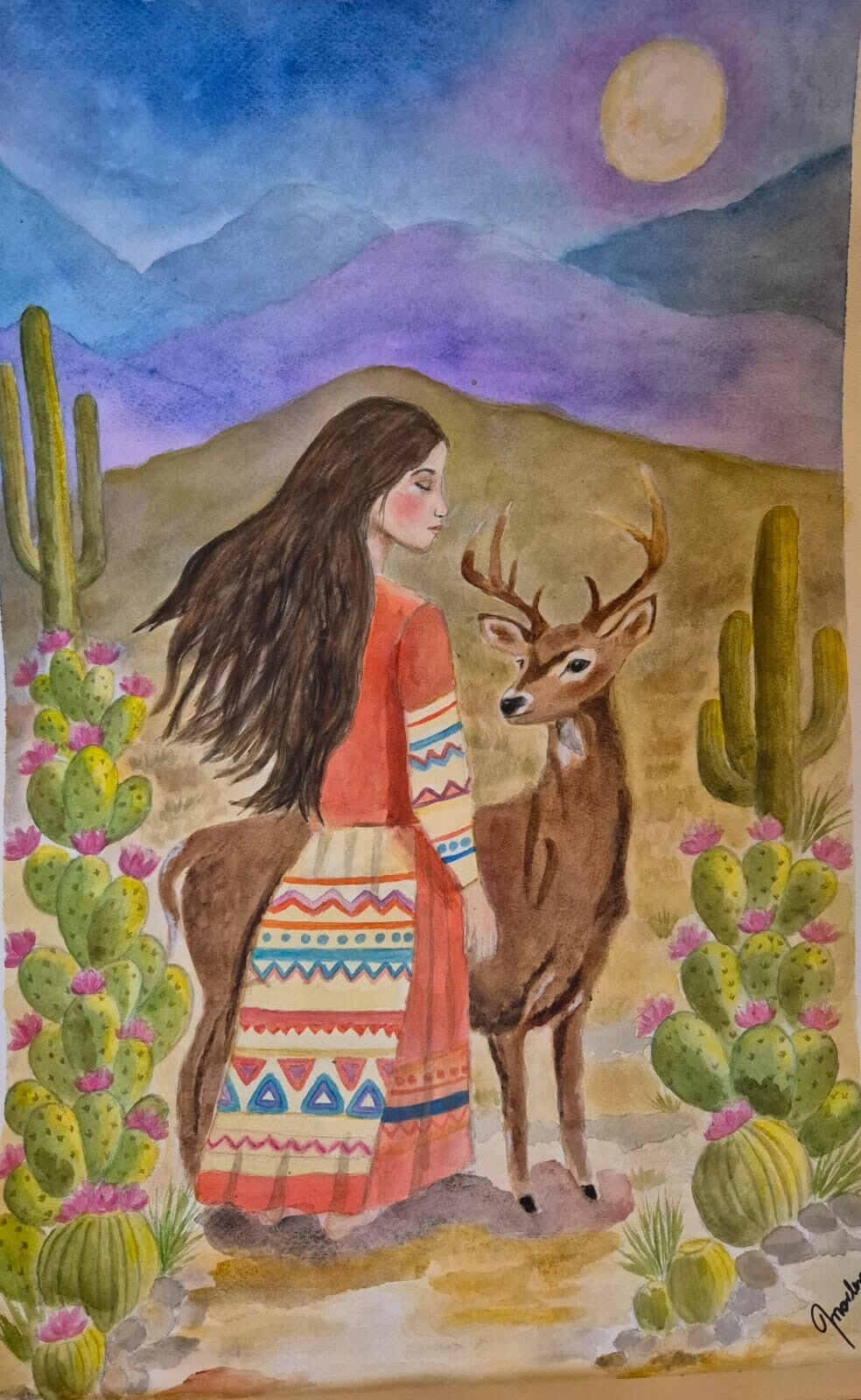
Painting by Marlene Pasini. She works with different techniques, including oil, watercolor, and acrylic. Photo: Courtesy of Marlene Pasini.
In a world saturated with social media, what do you suggest we do to avoid becoming slaves to it?
We currently live immersed in a world dominated by social media and technology, including artificial intelligence, and we are becoming increasingly attached to these media, running the risk of becoming dependent on them.
I believe one way to avoid this is to recover our interest in those activities that attract us and nourish us... art, writing, reading, history, music, sports, or any activity or discipline that awakens our sensitivity and creativity.
We must learn to make better use of the time we have and not lose sight of what truly gives meaning to our existence. We need to reconnect with nature, with divinity, and with everything we consider sacred.
Spend more time with the people we love, with our family, and with our companion animals. These deep and emotional connections can help us avoid getting lost in a virtual world that, although it has enormous possibilities, can also absorb a large part of our lives.
Among all the activities you undertake, how do you manage to divide your time and, of course, dedicate time to your family as well?
It is complicated because I really have very little free time available, and there are many activities that I have to attend to.
An important part of my time is dedicated to my family and my home. Like many women, I am a homemaker and a mother, and I also take care of everyday responsibilities: the house, cooking, and everything involved in maintaining a home.
After that, the time I have left I dedicate to painting, my literary projects, presentations, promoting my books, and all the activities related to my career.
I also dedicate time to my companion animals, who are a very important part of my life. And, I must confess, I sleep very little because I always try to find time for everything. There is also a part of my life that exists in the virtual world. My community on social media, particularly on Facebook, has grown considerably over the years.
And for me, many of the people who follow me have ceased to be simply followers; they are friends, colleagues, and, in many cases, they are part of my virtual family. Social media, for me, is a means of support for promoting my professional career. So, I also dedicate time to it.
What are the main themes addressed in your literary work?
My work revolves around themes related to spirituality, mysticism, and the testimony that remains through my travels and personal experiences. There is also a profound love for the sacred and for history, which appears in different ways throughout my books. For example, in my historical novel En la proa del tiempo, I address the period of the great maritime discoveries of Spain and Portugal, as well as some historical moments related to the Inquisition and alchemy.
I have also written essays related to women and the feminine, such as my book La mujer y lo sagrado, or works connected with different mystical traditions. One example is my book Un viaje por el camino del amor, inspired by Sufism. Other themes also encompass personal development, such as my book Coaching esencial, un viaje hacia el éxito y la trascendencia.
You have compiled several anthologies. What has your experience been like working with poets from different parts of the world?
As happens with many writers, throughout my career I have ventured into different areas of literature. Since I also have a publishing imprint, I became interested in contributing to the promotion of literature and art. That was how I began anthologizing and compiling works of both poetry and visual art, bringing together creators from different parts of the world.
For me, it has been a very enriching experience; however, it is not an easy task. Producing these anthologies has required a significant personal investment, both financially and in terms of time and effort. They have been projects that I have personally financed and, in addition, developed free of charge for the participants.
These anthologies continue to be available through Amazon and are part of my project Consciousness and Transformation. At present, I have decided to put this project on hold precisely because it requires a great deal of dedication in terms of time, work, and resources.
In your work as a visual artist, what message do you convey through your paintings?
One of the things I have tried to integrate into my visual work is precisely that universe of spirituality and the sacred that is also present in my literature. I work with different techniques, including oil, watercolor, and acrylic, and throughout my career as an artist I have experimented with different languages and processes. I have moved through figurative art and later also into abstract art, allowing myself to explore different forms of expression. On many occasions, my pictorial work and my literary work are intertwined. Throughout my career, I have participated in more than 350 art exhibitions, both virtual and in person, in more than 34 countries.
From Mexico, what message would you like to share with the world?
I believe that we are currently living through complex times, not only in Mexico, but practically throughout the entire world. We see it in wars, in the effects of climate change, in natural disasters and the aggression of nature, in social division, in violence, and in crime. All of this speaks to us of a time of profound changes for humanity.
I believe that precisely for this reason, we need to draw closer once again to our soul and our spirituality; to return to our point of origin, which is our connection with the sacred, with nature, and with the divine.
We also need to recover our most essential human values and act with ethics, awareness, and responsibility. Each one of us can contribute something from our own space, from our abilities, from our profession, and from the way we relate to others.
I believe we must begin with ourselves if we truly want to contribute to the transformation of this world. And although we often feel that we are living in a world that seems to be in collapse, I also deeply believe that every crisis can become an opportunity to awaken and transform our consciousness. My affection, as always, to everyone, and my blessings.
And I would especially like to thank you, dear Carlos Jarquín, for this interview and for the important work you carry out through your anthologies and your Canto Planetario, also contributing to the promotion of poetry, literature, and unity among creators from different places around the world.
Dear Marlene, from these lines, please accept my sincere congratulations for all the magnificent work you have accomplished and continue to accomplish. We wish you much success in each of your literary and artistic projects and in everything you undertake. Thank you for giving us the opportunity to make your excellent work known and to help disseminate it.
My dear friends and accomplices are invited to give themselves the opportunity to get to know this wonderful Mexican artist.
The interviewer is a Nicaraguan writer based in Costa Rica.
Carlos Javier Jarquín, known as “The Poet Boy” and “Poet’s Heart,” is a Nicaraguan writer, poet, columnist, cultural journalist, cultural manager, and international cultural promoter. Born on June 26, 1990, in Rancho Grande, Matagalpa, Nicaragua, and currently based in Costa Rica, he has developed a prolific career in literature and cultural journalism. His work encompasses poetry, chronicles, opinion articles, prologues, reviews, and interviews, and has appeared in publications and international literary anthologies. He has also served as a compiler and promoter of major international literary projects, including Antología del Bicentenario de Centroamérica and Canto Planetario: Hermandad en la Tierra, bringing together writers and artists from different countries and cultures. His career reflects a strong commitment to literature, cultural exchange, solidarity, peace, and environmental awareness.

Add comment
Comments