

By Carlos Javier Jarquín
Dear planetary friends:
Today, I have the pleasure of sharing an engaging interview I conducted with Palestinian poet, translator, and interpreter Alice S. Yousef. She was born on December 9, 1990, in Jerusalem, a beautiful and intricate city, full of pain but also deeply inspiring as one of the oldest cities in the world, with its magic reflected in multiple colors.
Alice is a poet, writer, literary and legal translator, editor, and researcher who works between Arabic and English. Her career focuses on the translation of legal and literary texts and poetry. She holds a Bachelor of Arts (B.A.) in English Language and Literature and Translation, with distinction, from Birzeit University (2008–2011). She obtained a Master’s degree in Creative Writing from the University of Warwick in the United Kingdom in 2014 and was a member of the International Writing Program at the University of Iowa in 2016.
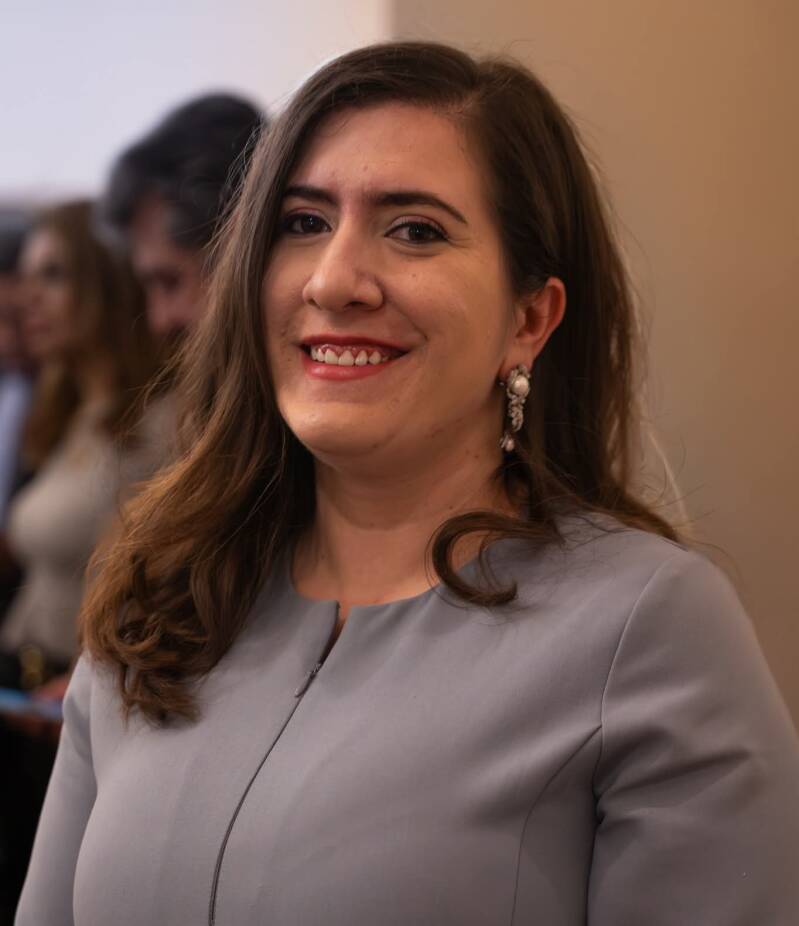
Alice, besides being an avid reader, loves languages, traveling, and dancing salsa and bachata. Photo courtesy of Alice S. Yousef.
In addition to translation, she mentions, “I am passionate about creative writing, research, and storytelling, with a particular interest in human rights, gender, disability rights, migration, and literature. My work is informed by a rich cultural practice and a global perspective, allowing me to approach complex narratives with precision and empathy. I currently reside in Palestine and dedicate myself to giving voice through language, interpreting, research, advocacy, visual representation, and the written word.”
Besides being an avid reader, she loves languages, traveling, and dancing salsa and bachata.
This year, she traveled to Colombia to participate in the International Poetry Festival of Medellín, held in its 36th edition from July 4 to 11 under the theme “Towards the Human Spring.” In this conversation, she tells us about her enjoyable experience visiting this South American country. She has traveled to more than 20 countries. She speaks four languages: her native Arabic, English, French, and Spanish.
In this interview, we discuss several topics. She tells us which book is her favorite and about the influence her parents had in turning her into an avid reader. She also talks about her literary style, how she developed it, and how she managed to find her own voice. She tells us about the main themes she addresses in her literary work. She also shares the good news that next summer she will publish her first poetry collection with a publishing house in the United Kingdom. The collection will be released in English.
At the end, Alice says goodbye by sending a message to humanity from that region of the planet that has been so wounded and has suffered so much. Decades have passed, and sometimes it seems that the world has forgotten Palestine; when we look at the news, it feels as though many do not remember that Palestine exists.
Interview
What do you remember most often from your childhood?
I grew up as the first granddaughter in a large family. I often remember everyday moments more than extraordinary ones: family gatherings, the rhythm of daily life, and the stories told around me.
I remember playing outside in the fields, visiting the Old City for the first time in my life and feeling that it was a labyrinth, my grandmother preparing pastries in the kitchen, and my parents reading to me. I also remember a great deal of fear because of the constantly changing political situation and witnessing war.
Growing up in Jerusalem also meant growing up with the awareness that even ordinary places contain layers of history and memory. Looking back, I realize that many of those small moments eventually found their way into my poetry.
What do you remember most fondly about your earliest reading experiences?
I remember the feeling of discovering that books could transport me to places I had never seen and, at the same time, help me understand the place I already knew. I remember the “one more chapter” or one more story before bedtime.
My parents read to me. I also remember hiding under the light of the side lamp to read until my mother gave up and said, “You’re going to damage your eyesight.” She was right.
I also remember that I had this magical gift of retelling the same story differently depending on the family member. I think that is where the seed of becoming a writer began to germinate.
Of all the books you have read, you choose The Kite Runner as your favorite. Why?

Alice S. Yousef (first in the second row) alongside poets from different countries attending the 36th edition of the International Poetry Festival of Medellín, held from July 4 to 11, 2026. Photo courtesy of Alice S. Yousef.
I choose The Kite Runner for the way Khaled Hosseini combines an intimate human story with broader themes such as guilt, memory, friendship, displacement, and redemption.
As a writer, I particularly admire his style: lyrical but restrained, emotionally precise, and without unnecessary embellishment. He knows how to make small details and moments carry enormous emotional weight while intertwining a deeply personal story with the broader history of Afghanistan.
For me, that is what makes the novel so powerful: it is rooted in a very specific place and history, but speaks to something profoundly universal about memory, remorse, and our longing for redemption.
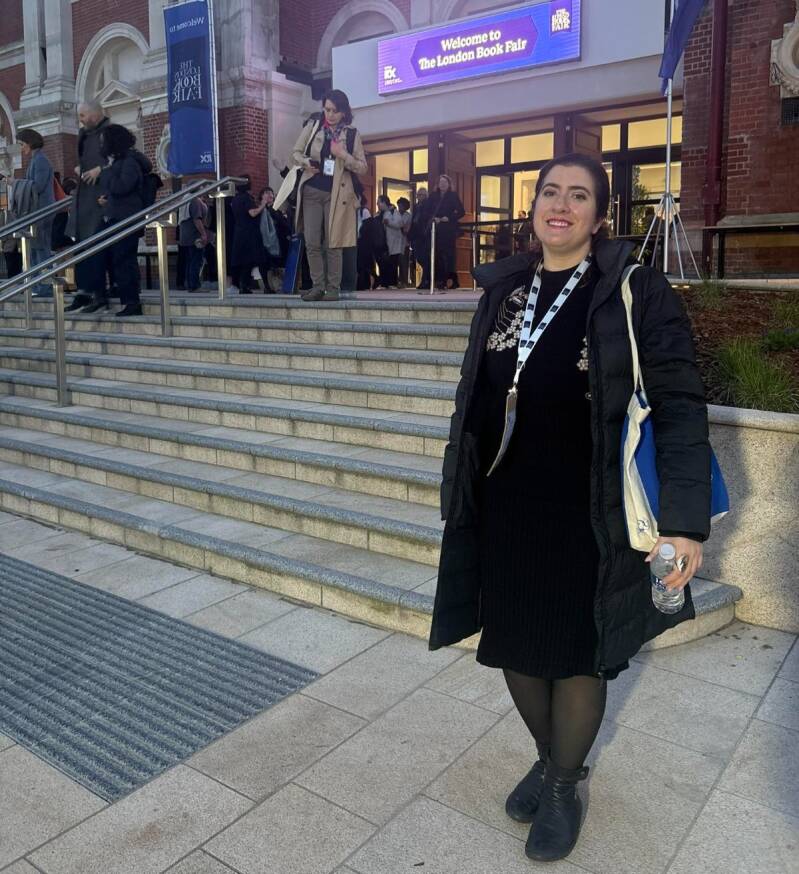
Alice S. Yousef holds a Bachelor of Arts (B.A.) in English Language and Literature and Translation, with distinction, from Birzeit University (2008–2011). She obtained a Master’s degree in Creative Writing from the University of Warwick (United Kingdom) in 2014 and was a member of the International Writing Program at the University of Iowa in 2016. Photo courtesy of Alice S. Yousef.
What inspired you to become a polyglot?
Curiosity, above all. Each language opens a new way of seeing the world. I am fascinated by words and their potential to change the way we see and understand what surrounds us.
I also love reading, and at some point, I want to be able to read my favorite authors in their native languages. Learning languages has allowed me not only to communicate with people from different cultures, but also to understand how ideas, emotions, and stories change as they move from one language to another. As a translator, I see language as a bridge rather than a barrier.
Can you summarize your experience in legal translation and interpreting between English and Arabic, specifying the types of documents you work with, such as judgments and bills, the types of simultaneous interpreting you provide, your contribution to judicial reform, and how you integrate a gender perspective and work with religious courts?
I am a certified legal translator and interpreter with more than a decade of experience building bridges between languages and cultures.
I have specialized in translating high-level legal documents, policy reports, and legislative texts between English and Arabic. I provide high-level consecutive and simultaneous interpreting services for legal and judicial meetings, workshops, and consultations, facilitating critical discussions on governance, justice reform, and legal aid.
I have developed an in-depth understanding of the rule of law, legal aid, legal education, gender mainstreaming, and the religious court system (family courts) through practical experience in legal translation and interpreting. I play a key role in multilingual legal communication, ensuring clarity in judicial proceedings, policy dialogues, and interactions with stakeholders. I work with a high degree of autonomy, handling sensitive legal documentation and contributing to strategic discussions with the justice sector.
Where did your passion for discovering new destinations come from?
I think my passion for discovering new places grew naturally from my love of literature. Long before I had the opportunity to travel, books allowed me to cross borders.
Reading taught me that every place has its own stories, but also that the emotions at the heart of those stories are extraordinarily universal. When I finally began traveling, I realized that, in a way, I was finding places I already knew through literature.
What had previously existed only in my imagination suddenly had faces, voices, landscapes, and conversations. Traveling became more than visiting new destinations; it became an opportunity to listen, learn, and establish genuine human connections.
What was the main lesson Warwick left you with?
Warwick taught me personal and professional lessons that will stay with me throughout my life. The most important was finding my voice, both on paper and in person.
I learned that writing is both a craft and a conversation. It encouraged me to experiment, question my assumptions, and read more generously across cultures.
Perhaps most importantly, it gave me the confidence to trust my own voice while remaining open to learning from others.
During your time in the United Kingdom, you lived near the house where William Shakespeare was born. How did you feel when you realized that detail?
It was a surreal feeling. Shakespeare’s work has traveled across centuries and languages, so being near the place where he was born reminded me that literature can survive its moments in time and space.
As a writer, it reinforced my conviction that stories belong to those who continue reading and reinterpreting them. It soon became my favorite place to escape from long and demanding study days.
What did the scholarship at the University of Iowa represent for your personal and professional life?
The University of Iowa’s International Writing Program was a transformative experience. It brought together writers from around the world and created a space where different languages, traditions, and perspectives could meet on equal terms.
On a personal level, it broadened my understanding of the global literary community. Professionally, it strengthened my commitment to international cultural exchange and gave me lasting friendships and collaborations that continue to inspire my work years later.
It was a deeply enriching experience.
When do you plan to publish your first poetry collection, and in what language will it be?
My first book of poems will be released next summer by the independent British publisher Broken Sleep Books. The collection will be published in English. I would love to see it translated into different languages.
What are the themes that stand out most in your poetry?
My poetry explores memory, identity, language, the world of women, displacement, love, and the quiet ways in which political realities shape everyday life.
I am interested in how ordinary objects and moments can contain extraordinary emotional weight. Translation also deeply influences my writing because I see poetry as another way of crossing borders and bringing different worlds into dialogue.
At the beginning of July this year, you were at the Medellín Poetry Festival in Colombia. What did that invitation mean to you?
It was an enormous honor and a deeply meaningful experience for me. The International Poetry Festival of Medellín is one of the most important poetry gatherings in the world, with a long history of bringing poets together in a city that has experienced profound violence and transformation.
Taking the stage as one of the few participating Palestinian poets had special significance. I felt that I was carrying not only my own work, but also the presence and voices of Palestinian women poets who are too often absent from major international literary spaces.
Being part of such a global festival gave me the opportunity to place Palestinian poetry within a much broader poetic conversation and to speak about our experiences, our history, and our present from our own perspective.
It was both a privilege and a responsibility, and an experience I will carry with me for a long time.
How would you describe your time in Colombia? Did you ever imagine visiting the land of García Márquez?
Colombia exceeded all my expectations. It is very vibrant and has emerged from a great deal of darkness. I felt at home.
I was deeply moved by the warmth and generosity of the people, the richness of their culture, and the genuine love for poetry that I found everywhere.
I had dreamed of visiting Colombia for a long time, and being literally at Márquez’s doorstep was a very emotional moment. As a longtime admirer of Gabriel García Márquez, visiting Colombia felt almost like entering a literary landscape that had lived in my imagination for years.
It was a beautiful reminder that literature can inspire us long before we arrive somewhere in person.
What impressions did you take away from Latin America to share with your homeland?
My first impression was: it is very green! I may be mistaken, but I was struck by the beautiful nature.
I love that Latin America is full of life. I returned with a deep appreciation for the resilience, dance, art, creativity, and generosity of Latin American communities.
Despite the different histories and languages, I found many shared experiences around memory, identity, and hope. I was especially inspired by the way poetry is embraced as a public and community art form, capable of bringing together people from all walks of life.
I do not think this was a one-time visit.
Do you consider that the world has forgotten Palestine?
I do not believe the world has forgotten Palestine. It is the oldest struggle living under occupation and war, but attention often comes in waves, as happens with the struggle for freedom everywhere.
What matters is that people continue to take an interest not only in the headlines, but also in Palestinian culture, its literature, its music, and everyday life.
Our stories are more than the news cycle, and art helps preserve the humanity that statistics and political debates often overlook.
What message would you like to share from Palestine?
I would like people to remember that behind every headline there are human beings with dreams, families, talents, and stories worth hearing.
There is always more than meets the eye. I hope those who read continue approaching Palestine with curiosity, empathy, and a willingness to listen.
Literature reminds us that, before being defined by nationality or politics, we are people connected by our shared humanity.
For me, that is where every meaningful conversation begins.
Dear Alice, thank you for dedicating your time and sharing your space from Palestine with the readers of this distinguished media outlet. Please accept my sincere congratulations on the career you have built throughout your life, both through your professional work as a translator and through your creative work.
At the following link, you can enjoy a poetry reading by Alice, which she gave during the International Poetry Festival of Medellín in Colombia last July:
https://youtu.be/aPHb3790R6c?si=e0BQHKJhOYXATTyE
Note: This interview was translated into English using Perplexity AI.
The interviewer is a Nicaraguan writer based in Costa Rica.
Contact: carlosjavierjarquin2690@yahoo.es
Add comment
Comments