

By José Luis Ortiz Güell
Faith, when it is genuine, makes no noise. It seeps in. It finds its way into the most unexpected corners and ties together destinies that, at first glance, might seem impossible to intertwine. Pope Francis knew this. Jorge Mario Bergoglio, the Argentine Pope who won the world over with his radical humility, always maintained a secret bond with Zaragoza. It was not a connection forged through official gestures or grand Vatican celebrations, but an invisible thread woven along the banks of the Ebro, nurtured by a faith that knows no borders.
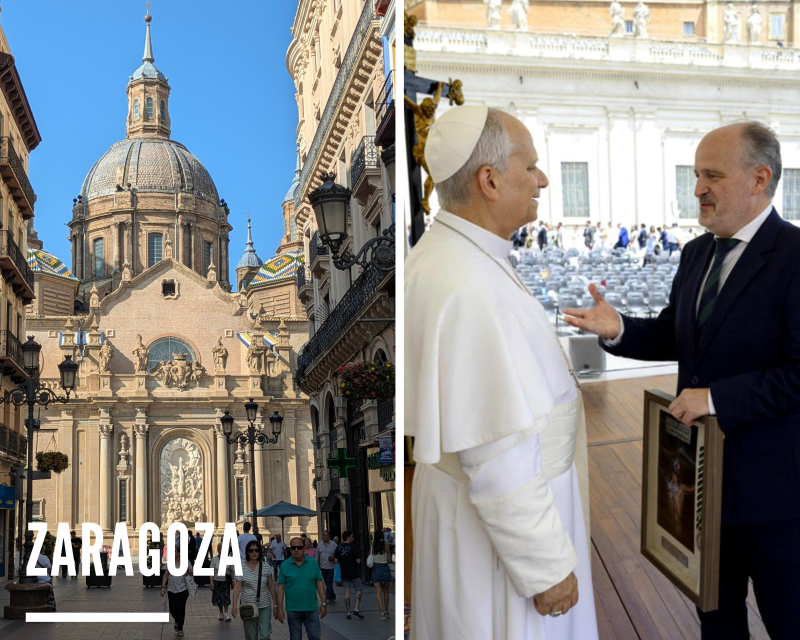
Many are unaware that Zaragoza, its Pilar and its Holy Week provided a refuge and a school for the Jesuit who would later change the history of the Church. Those who approach this city with an open heart will find, in its stones and traditions, the traces of a Shepherd who, even from afar, never ceased to pray for it.
It was 1971. Jorge Mario Bergoglio was a 34-year-old Argentine priest, ordained into the Society of Jesus just a few years earlier. Having recently been appointed Master of Novices of his order in Argentina, he travelled to Spain to complete his spiritual formation in Alcalá de Henares. But his spiritual curiosity led him a little further. He wanted to learn about a pioneering project: a Jesuit novitiate integrated into the very heart of a major city, an experiment in genuine engagement with everyday life. That project was in Zaragoza.
The Aragonese capital, with its cultural blend and popular faith, welcomed him into a small apartment at number 7 Paseo de Sagasta. There, on the fourth floor, Jesuit novices led lives devoted to prayer and study while remaining open to the street and to the city around them.
Bergoglio spent several days in Zaragoza, living alongside the novices and learning about their aspirations and hardships.
He celebrated Mass for them, and the few witnesses who remain from those days recall one unforgettable detail: the gentle Argentine accent of the young Jorge as he celebrated the morning Eucharist. According to veteran members of the Society of Jesus, that accent inspired tenderness and knowing smiles among the young men.
But the most moving moment of that visit, the act that forever sealed this mysterious connection, was a quiet and profound one. Bergoglio visited the Virgin of the Pillar and prayed before her.
Imagine him: a priest with his gaze lowered, his steps sure yet humble, kneeling before the jasper pillar where the Mother of God appeared to the Apostle James. The echo of his prayer mingled with the murmur of thousands of candles and the Ebro River flowing indifferently by.
The official history of the Church will record that Francis was the Pope who opened the doors of mercy. But in Zaragoza's intimate chronicle, he was that simple believer who, during one week in 1971, entrusted himself to the Virgin of the Pillar.
Bergoglio returned to Argentina, but a hidden corner of his heart remained attached to Zaragoza. Throughout his papacy, that connection resurfaced with an almost supernatural force through his friendship with Father Jesús María Alemany, a Jesuit from Zaragoza.
The two met during the Spiritual Exercises in Alcalá de Henares, and although distance and life eventually separated them, Francis kept the flame of their friendship alive as few others would. The Pope never forgot Father Alemany. The most moving expression of that remembrance, however, came on a particularly significant date: December 31, the Spanish Jesuit's birthday.
As if he had an alarm clock in his soul, Francis would ask every Aragonese delegation travelling to the Vatican: “Tell Father Alemany that every December 31, I remember him and pray for him.”
Father Alemany, who shared his memories with the media following the Pontiff's death, recalled with emotion: “Even after he became Pope, he remembered my birthday, something I find impossible to imagine any of our companions from those days remembering.”
Pope Francis, the Pope who avoided palaces and preferred the streets, never officially set foot in Zaragoza as Supreme Pontiff. Vatican politics and his fragile health prevented it, but the desire burned within him. Zaragoza was written into his private agenda.
Proof of that longing came in the summer of 2024. A delegation led by the President of Aragon, Jorge Azcón, the Mayor of Zaragoza, Natalia Chueca, and Archbishop Carlos Escribano was received by Pope Francis in a private audience at the Holy See. Their request was clear: to commemorate the 40th anniversary of John Paul II's visit to the Basilica of the Pillar by inviting Francis to repeat that historic journey.
The Pontiff's response, which subsequently reached the media, was a blessing for the Aragonese capital: the Pope assured them that he wanted to visit Spain, that he wanted to visit Zaragoza and that the trip was still “pending.” The door remained open. The people of Zaragoza, who already venerated him, intensified their prayers, hoping that the Holy Father's health would finally allow them to welcome him beneath the mantle of the Virgin.
But Zaragoza is not only the Pilar; it is also the Passion. It is home to Holy Week, declared an International Tourist Interest event. And at the heart of that Passion beats the Brotherhood of the Seven Last Words and Saint John the Evangelist.
Founded in February 1940, this brotherhood has a unique mission: to take to the streets at midday on Good Friday and proclaim the Seven Last Words spoken by Jesus Christ on the Cross. Its members do not simply carry religious floats; they stop the procession to proclaim the Gospel aloud to all citizens, a tradition dating back to 1940.
The connection between this brotherhood and Pope Francis goes far beyond protocol. To commemorate its rich history, the brotherhood's members published a book entitled Eighty-Five Times Seven. Aware of the Pontiff's sensitivity to stories of popular faith, they decided to send him a copy.
The response was not long in coming and exceeded all expectations. On February 5, 2025, having just emerged from a period of hospital treatment that had kept the world on tenterhooks, Pope Francis, in a remarkably warm gesture, sent a few words of thanks to the members of the brotherhood. The message, published by the brotherhood itself, was a balm for the city. Francis was not merely thanking them for the book; he was also blessing their mission of proclaiming the Word in the streets.
In a world that often rejects religious symbols, the Pope recognised in those men and women wearing white robes and green pointed hoods the true evangelisers of the streets.
Destiny, sometimes cruel to human plans, decreed that the long-awaited visit would turn into the most moving act of all. On April 21, 2025, the world awoke to the news of Pope Francis's death at the age of 88. The shock was global, but in Zaragoza, the grief had a particular accent. The city that had welcomed him in 1971, the city he had hoped to visit as Pope, was draped in mourning.
And this was no ordinary mourning.
On Sunday, April 27, 2025, the Cathedral-Basilica of the Pillar, the church Francis had visited as a young priest, proved too small to accommodate the crowds. Hundreds of people filled the main altar area for a solemn Mass for the eternal repose of the Pontiff. There was not room for another soul. Political authorities, led by President Azcón and Mayor Chueca, mingled with anonymous worshippers, members of the Brotherhood of the Seven Last Words and ordinary parishioners. The bells of the Pilar, silent witnesses to so many joys and sorrows, tolled for the dead with a deep, solemn sound that reverberated through every corner of the city.
The Archbishop of Zaragoza, Carlos Escribano, presided over the ceremony. His homily offered a synthesis of the Argentine Pope's legacy, which the prelate summed up in three words: joy, mercy and hope. In a moment of profound emotion, the entire church fell silent as a large portrait of the Supreme Pontiff was projected. The portrait looked out at the people of Zaragoza, and they looked back at him, knowing that they were gazing upon one of their own.
An event with the power to “convert unbelievers”? Because the story of Pope Francis and Zaragoza is not an article of abstract theology, but a chronicle of tangible humanity.
In times of cynicism and spiritual emptiness, Bergoglio's example is a whirlwind of authenticity. Here is a man, the leader of one billion Catholics, who was never embarrassed to remember the birthday of an unassuming friend in Zaragoza. Here is a Pope who, despite being the most powerful man in the Church, sent a humble message to a member of a religious brotherhood in response to a history book. Here is a Shepherd who prayed silently before the pillar of the Virgin long before the cameras ever focused on him.
If an unbeliever reads these lines, they will find no impossible dogmas or revealed truths beyond their reach. They will find a living testimony that integrity is possible. They will find proof that spiritual bonds transcend time and space. They will encounter the story of a Pope who preached through his life, transforming the coldness of protocol into the warmth of a sincere embrace.
The legacy is clear: Zaragoza is not merely a stop on the map. It is a place where faith took flesh in the heart of a modern-day saint. If you have ever doubted that the Church can be approachable, that prayer can echo beyond the moment, or that a man can change the world without hating anyone, all you need to do is walk along Paseo de Sagasta, listen for the echo of Bergoglio's Mass, or kneel at the Pilar. Francis is still alive there. There beats the heart of a Pope who chose Zaragoza to remind us that the joy of the Gospel is within reach of anyone who seeks it sincerely.
But this is no coincidence; it is a matter of cause and effect. The current Holy Father, Leo XIV, former Prior General of the Augustinians, wanted to include Zaragoza in his first trip to Spain, but was unable to do so and apologised for it. An old friend from Colegio El Salvador arranged for him to receive a ribbon of the Virgin. A new connection between the Pilar and the Vatican.
Between 2003 and 2006, Brother Robert Prevost, then Prior General of the Augustinians, lived in Rome alongside a young religious from Zaragoza, Pablo Tirado, who is now director of Colegio San Agustín in Zaragoza. Those years spent living together left an indelible mark. Now, as Supreme Pontiff, Leo XIV is making his first trip to Spain, and Tirado will attend the private meeting the Pope will hold with Augustinian religious.
On Sunday, May 18, 2025, the Cathedral-Basilica of the Pillar filled with worshippers for a solemn celebration. It was no ordinary day. It was the Mass of thanksgiving marking the beginning of Pope Leo XIV's Petrine ministry. Presided over by the Archbishop of Zaragoza, Monsignor Carlos Escribano, the Eucharist at the main altar of this pre-eminent Marian shrine was an occasion of profound emotion and also a declaration of principles: Zaragoza was blessing its new Shepherd and Leo XIV, although he did not yet know it, was beginning to look towards the Ebro.
The Pontiff has already made his wishes clear. On the flight that brought him to Madrid for this visit, a journalist from Zaragoza, Victoria Cardiel, approached him and, visibly moved, said:
“I am from Zaragoza, and the Virgin of the Pillar would never forgive me if I failed to bring you a ribbon of the Virgin.”
The Pope, with his palms pressed together in a gesture of apology, replied:
“Unfortunately, I cannot stop in Zaragoza this time.”
He added, with the knowing look of someone aware that a promise remains in the air:
“There will be another opportunity for me to visit the Virgin of the Pillar.”
Since the beginning of Leo XIV's pontificate, the brotherhood has followed his steps with devotion. Its members have even taken note of his first encyclical, Magnifica Humanitas, a text that courageously addresses the challenge artificial intelligence poses to the human person. On its official website, the brotherhood includes references to his speeches and a recurring message:
“In moments of darkness, God does not leave us alone,” a quotation from the Pope himself that the brotherhood's members have made their own.
Zaragoza Extends a Personal Invitation: “Zaragoza Awaits You”
While the papal schedule remains closed, Zaragoza native Pablo Tirado is preparing to attend Leo XIV's meeting with Augustinian religious in Madrid. His wish is simple, yet moving. He is not even asking for an official visit, only ten seconds alone with his former community companion to whisper in his ear:
“Zaragoza has its arms open to welcome you.”
Tirado remembers Brother Prevost from their years in Rome as a person who was “simple and approachable, all at the same time.” And he knows that the Pope who now speaks to the world from the Chair of Saint Peter is the same man who once shared everyday life in a community of dozens of religious. That is why he trusts that, even if the official visit is delayed, the Virgin of the Pillar will eventually draw Leo XIV to her shrine.
Faith does not understand deadlines or schedules. The Pilar has been waiting for pilgrims for two thousand years and will continue to wait for this Augustinian Pope, who, since his election, has shown a sincere desire to meet the patroness of the Hispanic world.
Pope Leo XIV already has his ribbon of the Virgin, a friend waiting to invite him, and a brotherhood praying for him. Zaragoza has become an outstanding commitment filled with faith and emotion. And so, even if for now it remains only a promise, every resident of Zaragoza knows that when his feet finally touch Paseo de Sagasta and he kneels before the Pilar, it will not simply be a Pope visiting a city. It will be a son of Saint Augustine returning home. And we will be there waiting for him with open arms, just as Pablo Tirado asked him to do.
Add comment
Comments