

With “Paris,” the musician embraces an expansive, global sound that challenges the established and marks a turning point.
By Susan Villa
At a time when flamenco fusion is experiencing unprecedented vibrancy, Aitor Palazuelo emerges with a proposal that defies labels and expands boundaries. His new single, “Paris,” marks the beginning of a more modern, expansive phase, clearly connected to the global sensibility of a new generation. Far from conforming to the traditional codes of the genre, the artist embraces a sound that breathes freedom—blending roots with electronic, pop, and Latin nuances—and reveals an emotional universe in full transformation.

With a career shaped by shared stages with top-tier artists—including members of the Gipsy Kings—and an authenticity perceptible from the very first chord, Palazuelo positions himself as one of the most restless and intuitive voices in today’s music scene. In this interview, the musician opens the doors to his creative process, the questions that have guided his evolution, and the energy that drives a phase in which deep connections, new sonic routes, and artistic ambition map out his next destination.
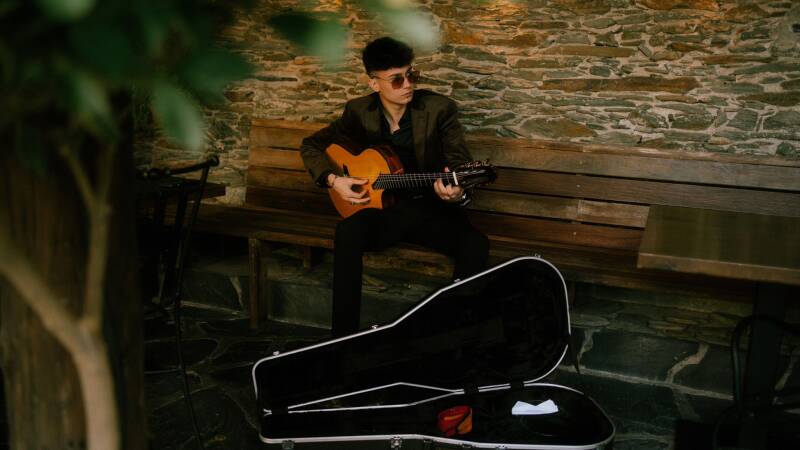
1. Your new single, “Paris,” inaugurates a “more modern and universal” phase in your music. What led you to take this stylistic turn, and what did you need to express that you couldn’t in your previous sound?
“Paris” was born from a personal need to open new windows in my music. I felt I had reached a point where I needed to explore a more current, expansive sound that could connect with people from different places and sensibilities. In my previous phase, I had found a lot of identity, but I also noticed that certain emotions and sonic landscapes were becoming too small for me. With “Paris,” I sought a sound that is more modern, more expansive, breathing freedom, and reflecting everything I’ve lived in recent years.
2. From a very young age, you showed an innate connection to the stage, and by 16 you learned guitar to gain interpretative freedom. How do you think this self-taught training has shaped your understanding of flamenco fusion?
Learning on my own taught me to listen to myself deeply and not be afraid to experiment. The guitar became an extension of what I felt, without strict rules, only intuition. I think that shows in how I approach flamenco fusion: I don’t see it as a closed genre, but as a space where I can mix, play, and let myself go. That freedom I experienced while learning—without pressure—continues to guide every musical decision I make today.
3. You have shared the stage with top-tier artists, including members of the Gipsy Kings. What did you learn from those experiences that now forms part of your identity as a musician?
From them, I learned something that no school can teach: the importance of energy. Seeing how they live music from such an authentic and visceral place left a deep mark on me. They showed me that technique is important, but what truly reaches the audience is the truth you convey.
4. Your first EP, “Mismo Destino,” marked a turning point in your career. What did you discover about yourself during that creative process, and what imprint did it leave on your artistic evolution?
With “Mismo Destino,” I discovered that I had much more to say than I thought. It was an EP that forced me to look within, to understand my fears, desires, and contradictions. It also gave me the certainty that I wanted to dedicate my life to this. The imprint it left is immense: it taught me to trust my vision and to build my own path, without rush but with conviction.
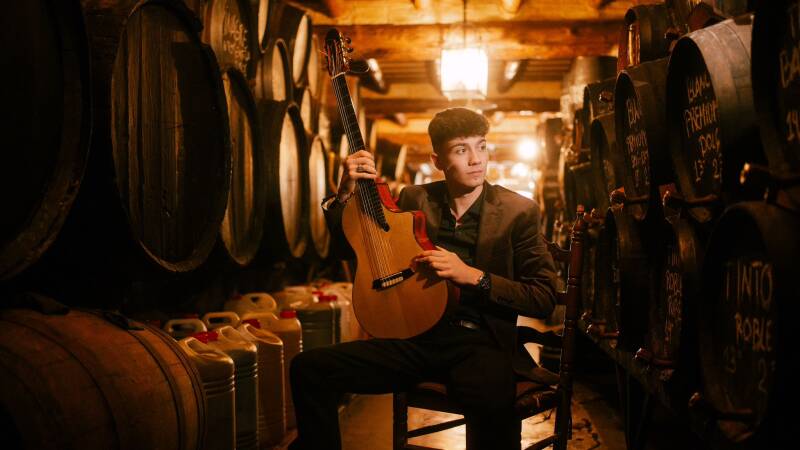
5. In “Paris,” you speak of soul connections and intertwined energies. What personal vision lies behind this reflection, and how did you transform it into melody and lyrics?
I have always believed that some people come into our lives as if they already knew us. “Paris” speaks to that feeling of deep recognition, when you connect with someone beyond the rational. I wanted to translate that into a melody that feels immersive, almost magnetic, and lyrics that travel between the earthly and the spiritual. It is a song born from real experiences and that intuition that souls sometimes meet because they were meant to.
6. At a time when flamenco fusion is experiencing great expansion, what do you think you bring to this genre that makes it distinct and recognizable?
I think I bring a very personal blend of flamenco sensitivity and a modern vision unafraid to incorporate electronic, pop, or Latin sounds.
7. Finally, this new phase seems to open doors to wider audiences. What projects are you currently working on, and how do you envision the next steps of your career?
Right now, I am working on new songs that follow this more modern line, but without losing my roots. I am also preparing a series of collaborations with artists I admire, which I believe will be very surprising. My next step is to take this sound to increasingly larger stages and audiences in different countries. I see myself growing, exploring, and enjoying the journey, always true to what I feel and what I want to express through my music.

Add comment
Comments