

By Susan Villa.
With a four-decade career, Juan Carmona has established himself as one of the great masters of contemporary flamenco. Born in Lyon into a Romani family, his art has flourished between deep roots and an insatiable musical curiosity that has led him to collaborate with artists from all over the world. In his new work, Laberinto de luz (Labyrinth of Light), the guitarist opens new harmonic pathways for flamenco, embracing a brighter sonic palette without losing sight of its essence.
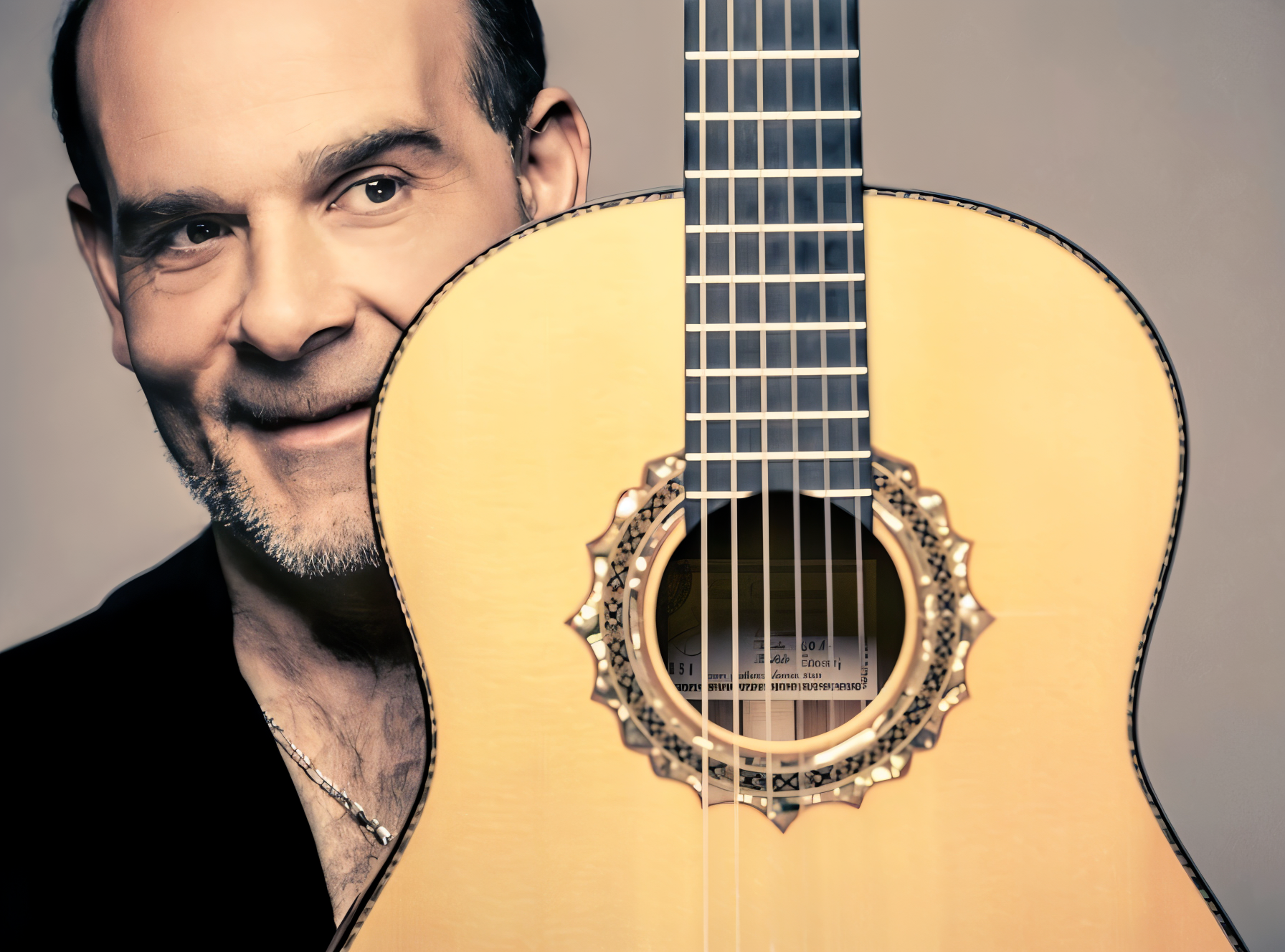
Beyond his work as a performer and composer, Carmona is the soul behind the festival Les Nuits Flamencas in Aubagne (France), a free, inclusive, and educational cultural initiative that for a decade has promoted flamenco as a living, diverse, and accessible art form. In this interview, we speak with him about his beginnings, the fusion of tradition and modernity, the lessons learned along the way, and the projects still beating on his creative horizon.
1. How did your family history and your environment in Lyon influence your development as a guitarist and your way of understanding music?
I come from a Romani family; flamenco has always been present in my home. I started when I was seven. For us, Christmas is very important, as it is in all families. In the case of Romani families, there’s always an excuse to bring out the guitar and sing. I remember that when I was seven, my uncle was playing—I didn’t play the guitar yet—and when I heard the sound of that flamenco guitar, it had a huge impact on me. From then on, I began to study; I learned on my own. Flamenco guitar is an oral tradition; it isn’t studied at a conservatory. My father bought me records. Every year I would see my uncle playing, and I learned that way.
2. What impact did your training in Andalusia with the great flamenco masters have on your artistic evolution?
At 27, I went to Jerez de la Frontera, which they call the cradle of flamenco. I entered the guitar competition and won it. At the same time I was learning, the best flamenco artists—like Agujeta or El Grilo—were calling me to accompany them. I was learning and performing at the same time.
3. Your work brings together flamenco, jazz, and Latin rhythms, among others. How can we balance the exploration of new styles without losing our cultural identity?
I don’t know how to play anything other than flamenco; it’s very important to me. It’s like a painter who, when creating a painting, has different colors at their disposal. I’ve been fortunate to live with and work alongside different musicians and styles—jazz, classical music, Brazilian music. I take all that musical information into my own territory, which is flamenco.

4. Your new album is titled Laberinto de luz. What does that “labyrinth” represent for you? What thread connects the pieces on the album?
Flamenco is based on a harmony known as the Andalusian cadence, which consists of four chords. With Laberinto de luz, I wanted to open up those four chords with a brighter harmony. Part of flamenco has darker sounds—the so-called dark side of flamenco—such as the cantes de la mina, which are more sorrowful. With this album, I want to show a side with more light, with color.
5. You collaborate with artists from different cultures and genres, including Al Di Meola, Tino Di Geraldo, Pablo Martín Caminero, and María Peláez. What role do these exchanges play in artistic growth and in building new forms of expression?
At first, I wanted to pay tribute to the female voice—that’s how this album began—but then I went on tour with the percussionist Mino Cinélu. There I met top-level musicians, including Horacio “El Negro,” the drummer for Santana and Chucho Valdés. I met Yelsi Heredia and Luis Guerra, who are Cuban. I wanted to give the album a more Latin jazz color.

6. In your work, you merge modernity with flamenco tradition. How can this search for balance be applied to other areas of knowledge and education?
I’m very clear about this: flamenco tradition is essential; you can’t make flamenco without knowing the tradition. You have to live in your time. Flamenco has evolved enormously, and I see that as positive. They can coexist perfectly when the history is known. I’ve been fortunate to play with the best cantaores from Jerez—El Capullo and Manuel de los Santos Agujeta. I’ve toured with Agujeta; he’s someone who truly knows the cantes and sings seguiriyas better than anyone.
7. After so many years in your career, how has the way you compose and understand music changed?
What the years give you is a certain positive attitude. For example, it’s not about whether music is pure or not—I don’t get into that. I consider purity to be what comes from the heart. A facet or an old French piece is pure. It’s pure if it conveys something, if it has heart.
8. What has been the most revealing moment in your artistic career?
In 1991, the first Paco de Lucía Competition was held. Paco reached an agreement with the artists—the singers and guitarists—on references and musical pieces. I entered and won the competition. Paco invited me to his home; we spent a very special afternoon that I still carry with me in my soul.
9. How do these milestones influence motivation and lifelong learning?
I’m fortunate to travel a lot; I’ve just returned from India. We’re putting together a project that mixes Indian music and flamenco. To create all that, it’s important to travel and meet many people.
10. You will soon perform with symphony orchestras. How does music transform when it encounters the power of an orchestra, and what lessons can we draw from teamwork?
Teamwork is very important; you have to know how to listen to others, and others have to know how to listen to you—otherwise it doesn’t work. In a project that mixes oral tradition, which is flamenco, with written tradition, there has to be an effort to understand both worlds. If you think the orchestra is going to play bulerías like someone from Jerez, that’s impossible. You have to be able to listen and stay attentive to other ways of fusing music. Classical music and flamenco have different codes, but flamenco projects can be created in this way.

11. What sensations and emotions would you like the audience to experience when listening to Laberinto de luz for the first time?
I would like this project to open the audience’s mind. You shouldn’t stay stuck in what you think is best. Human beings are curious: they read a book and are convinced it’s the best book in the world because they’ve read it; they watch a film and tell you it’s the best. I want people to see that flamenco can be done in another way, with a blend of other musical cultures. I hope to open minds.
12. After so many achievements and international collaborations, is there any project or collaboration you still dream of carrying out in the future?
The project with Indian musicians, because they have something I really like: they carry rhythm in a way that’s different from flamenco, where rhythm is of great importance to them. Rhythm is fundamental. I hope it will come to light soon—working in progress. I hope to do it here in Madrid soon.
13. Les Nuits Flamencas stands out for its inclusive, multidisciplinary, and educational approach. How has your vision of the festival evolved since 2015, and what role do you think it plays today in promoting flamenco internationally?
Our festival has evolved greatly over ten years. Initially, we focused more on tradition, and over time we’ve managed to educate the audience to embrace new and contemporary proposals, and above all, to present flamenco art as something that encompasses not only music or dance, but also film and fashion.
For example, we’ve programmed cult films such as Carlos Saura’s flamenco film, or Jorge Pardo’s, which offers a different perspective to the viewer. We’ve also presented avant-garde dance proposals, like last year’s performances by Andrés Marín or Manuel Liñán, with men dancing dressed as women.
Today, after ten years of the festival, the audience is willing to welcome any style of proposal because it is far more open. The programming reflects what I want to represent in my music: diversity.
As for the festival’s international impact, I can say it plays a fundamental role, because today in Spain many major flamenco figures are proud to perform at NF Aubagne. They know the festival is free and that it helps democratize flamenco culture and make it accessible to everyone, fostering inclusion and social diversity and offering performances to a different audience.
14. Les Nuits Flamencas is characterized as a free, accessible festival with core pillars such as transmission and pedagogy. Why do you consider it essential to maintain these values, and how have they helped build the spirit of the festival over the years?
One of the pillars is education, because we must not forget that we are in a foreign country and that flamenco remains a minority musical culture. Therefore, it’s important to educate young audiences. That’s why we’ve implemented an artistic and cultural education program in the city’s primary schools. Before the festival, I meet with children at schools to talk with them and raise awareness about flamenco culture. During the festival, there are also children’s activity areas for our younger attendees.
As mentioned earlier, free admission and social inclusion are the values and the DNA of the festival. This free entry allows us to transmit our values to as many people as possible—whether in terms of promoting flamenco culture or the festival’s eco-responsible dimension (waste management, reduction of plastics, decorating the festival with recycled materials, etc.), or even organizing ecological walks with children to collect waste.
This festival works because it promotes values that reflect us and bring us together.

Add comment
Comments