

On the afternoon of January 28, I had the privilege of attending the presentation of the musical album Suite Guitarra Social by the Costa Rican singer-songwriter, poet, and academic Natalia Esquivel Benítez. The event took place at the Benemérita National Library of Costa Rica and was organized by the Ministry of Culture and Youth, through the Benemérita National Library (part of SINABI), the Humanistic Training Area of UTN, the cultural collective Trébol Carmesí, and Natalia Esquivel.
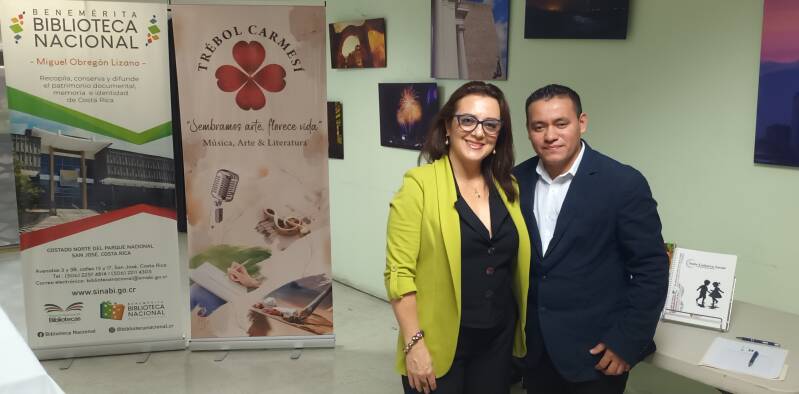
In the photo, Costa Rican singer-songwriter Natalia Esquivel Benítez and Carlos Jarquín pose during the presentation of the album Suite Guitarra Social, held on January 28, 2026, at the Benemérita National Library of Costa Rica.
Credit: Gaston Umaña.
The activity began at 4:00 p.m. Following the welcome from the Director of the National Library Miguel Obregón Lizano, Ms. Laura Rodríguez Amador, the moderator Nayuribes Ramírez Jiménez delivered an excellent introduction and handed the floor to the artist. In her speech, Natalia explained:
-
"Suite Guitarra Social is a collection of 17 original pieces for solo guitar, composed during an artistic residency in Cáceres, Spain in 2024 under the mentorship of Maestro Marta Lozano Molano. Each piece is inspired by a Sustainable Development Goal (SDG) of the United Nations, aiming to generate ecological awareness, solidarity, and ethical reflection through music. The work was supported by the Ibermúsicas program and the National Technical University of Costa Rica, and was awarded the declaration of cultural interest by the Ministry of Culture in 2024. It has been performed in educational recitals and interdisciplinary concerts, and disseminated through cultural media such as Revista Latina and Revista Arjeé of UTN. It is aimed at young performers and music educators, who will find in this Suite a technically accessible repertoire that intertwines sound poetry with social and ecological commitment."
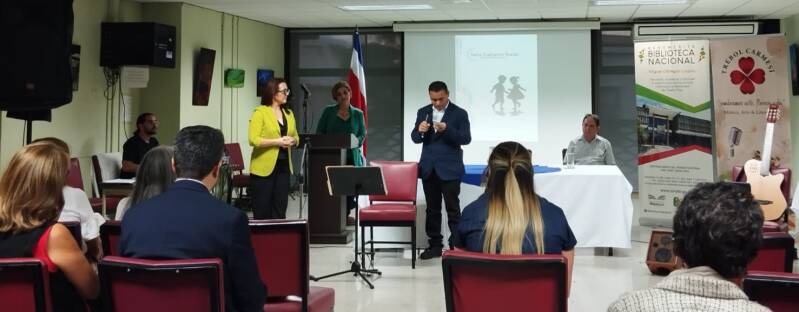
Carlos Javier Jarquín (center, standing) during the presentation of Suite Guitarra Social at the Benemérita National Library of Costa Rica. Photo: 01/28/2026. Credit: Juan Carlos Chavarría.
She also highlighted: "Suite Guitarra Social is not just a set of concert pieces; it is a tool for dialogue, an invitation to build community through music, and an example of how art can have a pedagogical and transformative purpose, fulfilling its role in the humanistic field. In times that call for a new ethic of care and cooperation, this work has been composed as a creative beacon to illuminate the intersection of art, ecopedagogy, and global citizenship."
Guests acting as commentators contributed valuable insights during the presentation: music professor Mario Solera and philosopher and academic Osvaldo Matamoros Zamora. Both emphasized the relevance of Suite Guitarra Social in today’s times, especially for children, adolescents, teachers, and anyone wishing to embark on the art of music, particularly the guitar.
During the event, a video sent from Spain by Maestro Marta Lozano Molano was also shown, in which she said: "Natalia Esquivel is an excellent composer, and I am sure she will inspire you as much as she inspired me with her work. In this Suite Guitarra Social, I had the fortune of witnessing her creation during the composition residency in Spain with Ibermúsica. It was a wonderful experience: throughout the week she was here, we had the opportunity to better understand social music, how it works, its sustainable development goals, and musical work in Spain, particularly in the region where I am located."
We also enjoyed poetic moments with singer-songwriter Alba C. Molina, who recited a poem dedicated to the guitar, authored by Nayuribes Ramírez. Ligia Calderón performed a poem of her own creation dedicated to Natalia Esquivel, and Nayuribes Ramírez delighted us with the reading of one of her beautiful poems.
The closing was sensational: Natalia Esquivel and Maestro Mario Solera performed all 17 pieces that make up this album Suite Guitarra Social, delighting both the attendees present and those connected virtually through the National Library’s Facebook page.
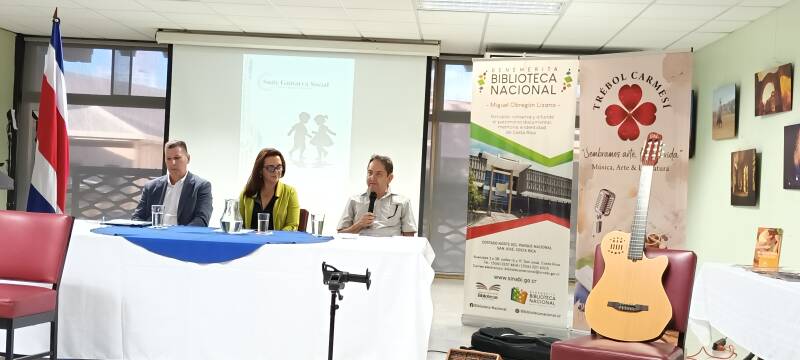
From left to right: Osvaldo Matamoros Zamora, Natalia Esquivel Benítez, and Mario Solera. Photo: 01/28/26. Credit: Carlos Jarquín.
From this space, I extend my sincerest congratulations to Natalia for this great work, and to everyone involved, such as Ibermúsica for opening doors to this distinguished Latin American composer; to composer Marta Lozano Molano, accomplice and mentor in this prominent work, which is already emerging as a true musical reference from this corner of the planet called Latin America to the world.
In the words of its author: "Suite Guitarra Social is a pedagogical work and proposal for guitar that connects music with reflection and social values, ideal for guitarists, music teachers, and artists interested in meaningful creation." Digital edition available with immediate download after purchase. Acquire it here: https://n9.cl/907r0
To learn more about this work available on digital platforms such as Spotify and YouTube, I invite you to read the interview I conducted with Natalia, where we delve into this musical gem for its fresh, reflective, and globally relevant content.
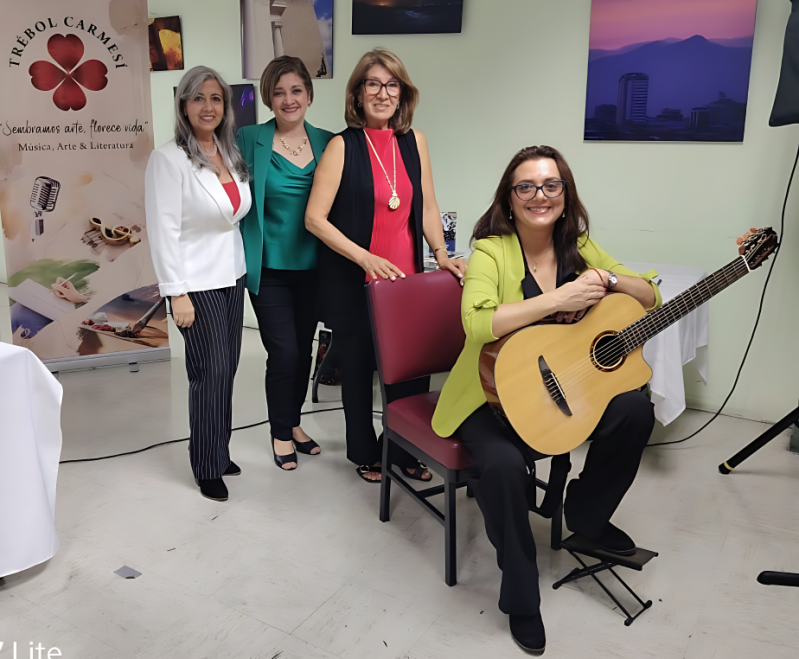
Members of the cultural collective Trébol Carmesí. From left to right: Alba C. Molina, Nayuribes Ramírez Jiménez, Ligia Calderón, and Natalia Esquivel Benítez, during the presentation of the musical album Suite Guitarra Social at the Benemérita National Library of Costa Rica. Photo: January 28, 2026. Credit: Carlos Jarquín.
Interview
What are the central themes addressed in Suite Guitarra Social?
Suite Guitarra Social addresses themes related to values education, social awareness, the human relationship with nature, and the construction of a culture of peace. Each piece engages with the Sustainable Development Goals, understanding music as a sensitive language capable of provoking reflection, empathy, and social transformation.
What are the main harmonic characteristics of this work?
The work is characterized by accessible yet expressive harmony, combining extended tonality, modes, and contemporary resources without losing melodic clarity. The guitar is used narratively, emphasizing color, timbre, and musical gesture as expressive elements beyond technical virtuosity.
What cultural influence does Suite Guitarra Social reflect or integrate in its composition?
The suite integrates influences from Latin American music, the Ibero-American guitar tradition, and a contemporary perspective committed to social and educational concerns. It also engages with ancestral knowledge, ecopedagogy, and an intercultural vision that recognizes music as living heritage and a tool of identity.
Tell us about piece number 15, titled “Iyök amì tsé.”
“Iyök amì tsé” is a deeply symbolic piece that pays homage to indigenous peoples and their worldview. Its title, from an indigenous language, evokes the sacred connection to the earth and the balance among living beings. Musically, the work seeks a contemplative, almost ritualistic character, where silence and resonance play a central role.
What are the objectives of converting this musical album into book format?
The book format allows expanding the artistic experience into a pedagogical and reflective domain. It not only contains the music but also contexts, guidance, and educational use possibilities. The goal is for performers, teachers, and cultural mediators to use the work as a formative resource, not just as concert material.
How would you describe your experience working with Spanish composer Marta Lozano Molano?
It has been a highly enriching creative dialogue, based on mutual respect and shared artistic sensitivity. Marta contributed a rigorous yet open perspective, which strengthened the creative process and reaffirmed the value of collaborative work among female creators in the musical field.
What challenges did you face in undertaking this initiative?
One of the main challenges was coherently integrating artistic creation, the educational dimension, and cultural management. It also involved sustaining the project through self-management, believing in the social value of music in a context where such projects require great consistency and conviction.
What does it mean for you to have presented this work at the Benemérita National Library of Costa Rica?
Presenting Suite Guitarra Social at the Benemérita National Library of Costa Rica represents a highly significant symbolic recognition. It is a space that preserves the country’s cultural memory, and bringing there a work that unites music, education, and social commitment was profoundly meaningful and moving. It was also a reminder of the valuable support I have fortunately received throughout my artistic and educational journey; a gesture of shared friendship with the Library family, my artistic collaborators, and the public in general.
Can you tell us about any literary or musical projects you are currently working on?
Currently, I am working on projects that integrate poetry, music, and education, as well as new musical works designed for performers and educational contexts. I am also developing initiatives linked to promoting reading and musical training with a humanistic and social approach, continuing the line of work that gave rise to Suite Guitarra Social.

The author is a Nicaraguan writer and poet residing in Costa Rica.
Contact: carlosjavierjarquin2690@yahoo.es
Add comment
Comments