

The Portuguese artist Edgar Pinto explores desire, memory, and Andalusian roots in a release that definitively consolidates his international projection in current Iberian markets.
By Susan Villa.
Eddie (Edgar Pinto) has built a career marked by the dialogue between Iberian and Latin American musical cultures, moving naturally between Portugal, Spain, and the Lusophone universe. A producer, composer, and multidisciplinary artist, his trajectory reflects an artistic identity that combines emotional sensitivity, studio experience, and an open approach to different sonic languages.
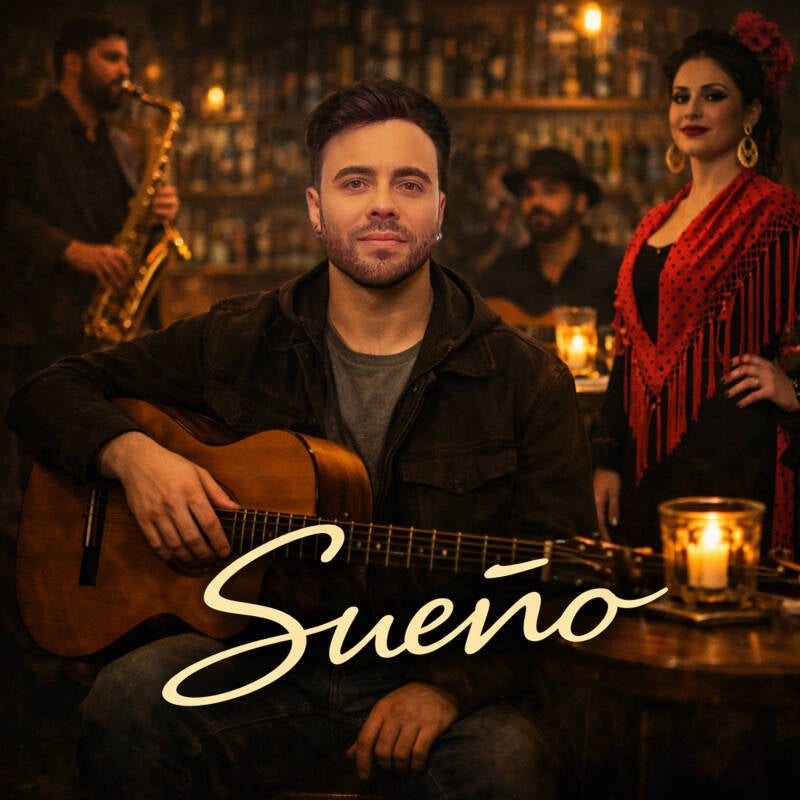
With Todo a Su Tiempo, Eddie presents a stage of artistic maturity in which he consolidates a personal language built over several years. Within that universe comes Sueño, a pop ballad with a flamenco touch, traversed by desire, doubt, and emotional intensity. Inspired by Andalusia and the artist’s personal connection with Seville, the song delves into that intimate space where emotional memory and unresolved feelings coexist.
Coinciding with the expansion of this new work and the release of Sueño, Eddie arrives in Madrid at a key moment of artistic consolidation. In this interview with Susan Villa, the artist reflects on his influences, the construction of his musical identity, the symbolism of Seville in his creative imagination, and the next steps of a project that continues to grow across different markets and stages.
1. In your early days as an artist, which musical references and personal experiences shaped the path that led you to build your creative identity as Eddie (Edgar Pinto)?
It was a process that was built over the years. I grew up surrounded by different influences. Portugal, the proximity with Spain, the Lusophone diaspora, and the Latin American sounds that arrived through Spain were part of my environment from an early age. Very early on I started working in studios, producing and writing, and there I understood how a song is truly built. Eddie is born from that place: from creation, studio experience, and practical knowledge of the musical process.
2. Your career is characterized by a constant dialogue between Iberian and Latin American cultures; how has this cross-cultural universe influenced your artistic and sonic evolution?
I experience it as a natural consequence of my journey. I live between Portugal and Spain, and my relationship with Latin America is a real part of my life and work; it is reflected in the contexts where I move, in the people I work with, and in the circulation of music itself. Over time I understood that my place is not in choosing a side, but in moving within that shared space. That allows me to work freely, without needing to fit into a specific label. I prefer to let each song find its own shape and language.
3. Your new album Todo a Su Tiempo reflects a specific stage of your career; what meaning does this work have within your artistic evolution?
It is an album that marks a point of maturity. It summarizes a journey of several years in which I was building and expanding the language, the criteria, and the direction of the project. There has been a natural refinement regarding what should remain and what should not, both on an artistic level and in the construction of each song. There is also a great respect for the timing of processes. More than a closure, I see it as a solid foundation from which to continue moving forward.
audience with this song?
Sueño is built from a very specific atmosphere, with a pop base and a flamenco touch that accompanies the emotional tone of the song. It starts from a recognizable feeling: the doubt about a bond that is still present, but whose form is no longer clearly recognized. There is desire, there is distance, and a certain emotional tension that runs through the entire piece. It does not aim to close anything, but to leave space for each listener to interpret it from their own place.
5. You chose Seville as the setting for the music video for Sueño; what symbolism does this city have in your artistic imagination and in your personal story?
Seville has been part of my journey for many years and is directly linked to my relationship with Andalusia. It is not a one-off aesthetic choice; it is a place that exists in my imagination and in my trajectory.
4. In the single Sueño, what do you want to convey to the
I had already worked with that universe in El Otro Lado de Mí, and returning now with Sueño brings continuity. The video, directed by Rafael Choclán, is based on that real relationship with the city. It uses recognizable spaces without falling into a superficial reading. That gives the piece context and coherence.

6. Your music addresses complex emotions such as desire, doubt, or emotional memory; from your perspective, what role does emotional honesty play in contemporary music creation?
Connection with the audience depends largely on the coherence between what is done and what is conveyed. I understand emotional honesty as working from a real place, without forcing emotions or building something that has no foundation. When the intention is clear and the song is well constructed, connection happens.
7. With your arrival in Madrid to present this new work, what projects and goals do you have in the short and medium term after the release of Sueño and the consolidation of Todo a Su Tiempo?
Madrid has been part of my journey for years, both personally and professionally, and it has a real weight in the development of the project. Arriving now with this work responds to a logical continuity. In the short term, the focus is on continuing to promote Sueño, both the video and its presence in the media.
Also strengthening the visibility of Todo a Su Tiempo. In the medium term, the goal is to reinforce the live structure, expand presence on stages, and continue consolidating a project with real presence in different markets.
Add comment
Comments