

Culture
By José Luis Ortiz Güell
There are nights that are not measured by the clock, but by the pulse. Nights in which the brightness of the spotlights does not dazzle, but instead illuminates what is essential. On February 14, at the SB Diagonal Zero Hotel in Barcelona, the 5th edition of the Ibero-American Business Awards (PRIE) demonstrated that recognition, when granted with purpose, can become a mirror in which the best of a community is reflected.
Twelve categories. Twelve stories. Twelve ways of understanding that entrepreneurship is not only about making money, but about leaving a legacy.
There they were, representing the lifeblood that drives Ibero-American development: Tentación Criolla in Gastronomy, bringing the flavors of our land to new horizons; María Barcelona in Beauty, showing that aesthetics can be art; Dental Gloria in Health, caring for what is most precious; Soraya Quintana in Literature, building worlds with words; Tony Rodríguez in Business, weaving the future of the productive sector; Diego Mejía in Professional Career, an example of consistency and excellence; and Fundación Espartanas in Social Work, reminding us that no one is saved alone—along with the other award winners who completed an exceptional map of Ibero-American talent.
But there was a precise moment when the evening stopped being a gala and became a statement of principles. It happened when Blanca Rigau, creator of the sustainable and inclusive brand that bears her name, stepped onto the stage to receive the Fashion award.
The jury—composed of Yamira Guijarro, author of Abundancia de vida; Ángel Higuera, owner of the restaurant Tío Papelon; Marco Sánchez, lawyer and president of the Association of Ibero-American Professionals; Pilar Espinoza, dentist and owner of Clínica Mar Dent; and Brenda Zambrano, director of Xatruch 504, the first Honduran newspaper in Spain—had made it clear that Rigau’s trajectory deserved this recognition. Not only for the excellence of her designs, but for her commitment to a fashion that celebrates diversity in sizes, ages, and ethnicities, promoting a vision in which beauty is born from authenticity and respect.
There they were, among the attending authorities, Ernesto Carrión, member of the Parliament of Catalonia; Jordi Martí Galvis, councilor and president of Junts Barcelona; Susana Cleresi, Secretary of Migration of the PPC and councilor of the Horta district; Gina Pol, Secretary of Equality of the Government of Catalonia; and Marco Sánchez, also present as part of the jury. All of them were joined by entrepreneurs and professionals from different parts of Ibero-America. “This nomination,” Rigau began with a serenity only deep conviction grants, “is a reminder of everything that becomes possible when fashion serves a purpose greater than itself. When it walks hand in hand with courage. When it chooses compassion.”
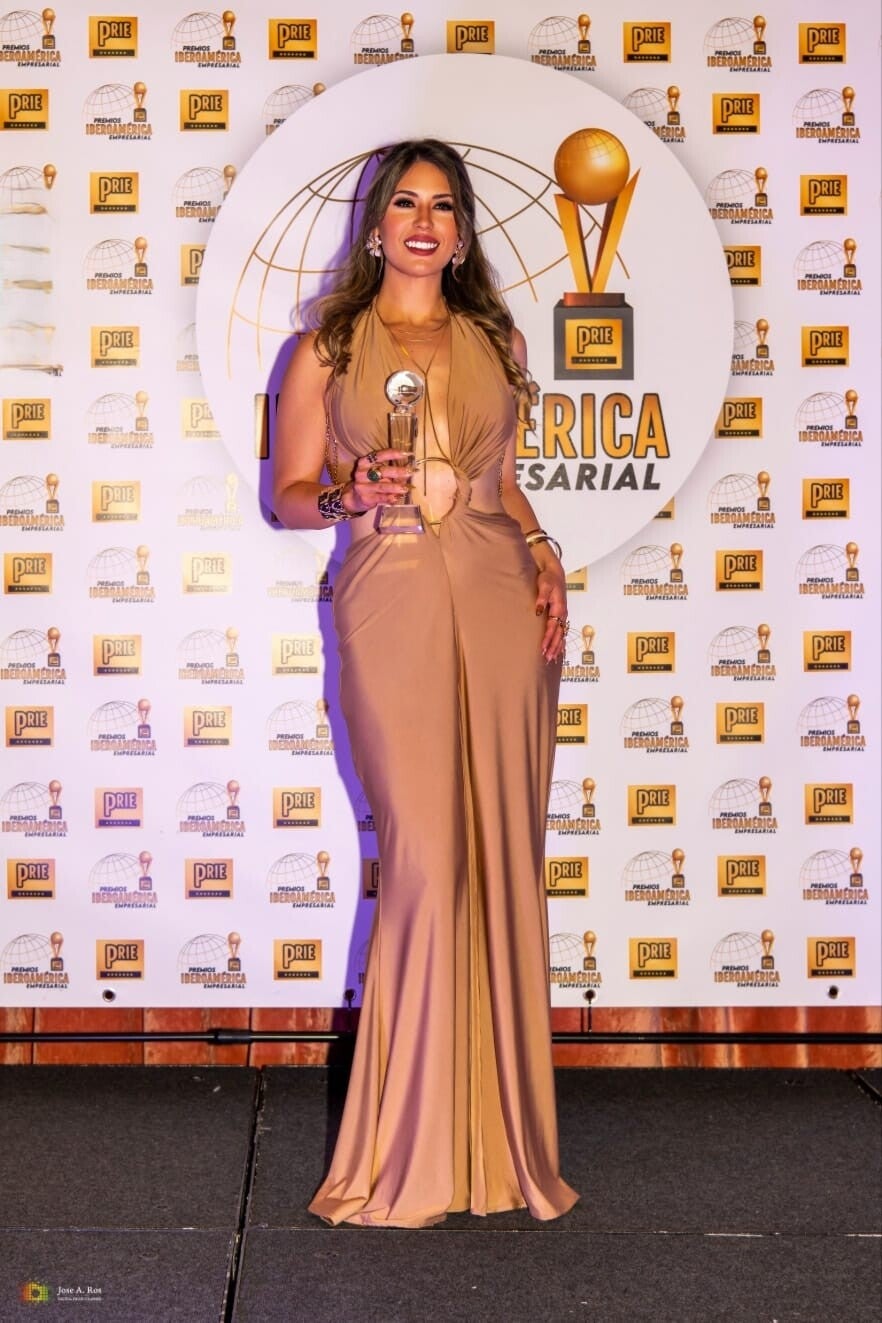
And then her words stopped being those of a grateful award recipient and became a manifesto, a declaration of intent. “Because when we dress,” she continued, “we do not only cover bodies. We build confidence. We restore dignity. And we tell the world that those who have been ignored, silenced, or hurt are seen, matter, and their story has value.”
That is where the greatness of Blanca Rigau lies. Not in the dresses she designs, but in the vision with which she conceives them. For her, fashion is not frivolity. It is a tool of social transformation. It is armor for those stripped of dignity. It is a banner for those who have been silenced.
Blanca dedicated the award to those who have suffered bullying or have doubted themselves. “The body always changes,” she reminded, “but the essence remains.” And she delivered a message of encouragement to all those who have ever felt invisible: with determination and perseverance, dreams can come true.
I have covered dozens of galas throughout my career. I have seen artists cry, entrepreneurs become emotional, politicians fake feelings they did not have. But it had been years since I witnessed someone speak about their work with such conviction, almost mystical.
And then came the promise. The one that separates true leaders from mere incidental occupants of success:
“I promise to continue using my voice, my work, and this platform to defend kindness, justice, and inclusion. Not as an idea, but as action. Not someday, but now. As a team, because together we always go further.”
The auditorium erupted in applause. It was not the polite applause of protocol. It was that deep, visceral applause that cannot be faked—the one that recognizes when someone has just spoken an uncomfortable and necessary truth.
After midnight, as guests began to leave the SB Diagonal Zero Hotel, something lingered in the air. Something that went beyond the success of a well-organized gala. What remained was, above all, the certainty of having witnessed something important. Not a simple awards ceremony, but a collective affirmation that another world is possible. A world where success is built collectively, where beauty has purpose, and where twelve stories—the stories of all the award winners—remind us why it is worth waking up every morning to build, create, and dream.
Because in the end, as Blanca Rigau said, it is not about ideas. It is about actions. Not about someday. About now.
And that night in Barcelona was the moment of twelve entrepreneurs who proved that Ibero-America is not just a geographical concept: it is a way of understanding the world.
Add comment
Comments