

By Carlos Javier Jarquín
Dear planetary friends:
Technology, if used appropriately, can be a tool of great positive influence in the life of every citizen. Of course, in a world saturated with technological advances, there is also a negative side: that dark world of self-destruction and distraction, driven by social networks that emerge abundantly. It is easy to get lost in them, and we can all be affected if we do not have a clear agenda for our daily work. Undoubtedly, the most vulnerable are young people, who run the risk of becoming excessively distracted.

Emmanuel Marete, at the age of 14, published his first book, Dawn to Dust – Echoes of a Wounded Soul (Mystery Publishers Limited, 2025).
But there are always exceptions, and today I present to you my Kenyan-American poet and student friend Emmanuel Marete Kimathi, son of the renowned Kenyan poet Jerusha Kananu Marete. Emmanuel currently resides in Columbus, Ohio. His work explores mental health, identity, and resilience in adolescence, combining emotional introspection with admirable structural clarity. At just 15 years old, this brilliant young man already stands out internationally in the poetic world. He has grown up in a privileged environment—his mother is a poet, and part of his family is involved in professions such as law, engineering, medicine, neuroscience, cybersecurity, education, banking, economics, finance, insurance, politics, and business, which he himself mentions as a source of motivation.
This talented young man speaks three languages: Kimeru, Swahili, and English. At 14, he published his first book, Dawn to Dust – Echoes of a Wounded Soul (Mystery Publishers Limited, 2025). The publisher describes it as: “Emmanuel Marete Kimathi, aged 14, presents a deeply moving collection of poems that delve into the essence of human struggle and resilience. Through evocative verses, Emmanuel paints a raw portrait of inner turmoil, societal pressures, and the relentless pursuit of redemption. Each poem pulses with the weight of a wounded soul seeking light among shadows, offering comfort to those who feel unheard and invisible.”
Dear readers, Emmanuel is truly a Kenyan prodigy. He learned to read at age 3 and began writing poems at age 9. In this interview, he speaks about his discipline in using the internet productively, his passion for reading on diverse subjects, and his plans to study neuroscience, finance, and software engineering. I hope you enjoy this interesting conversation, which will undoubtedly motivate you to grow and, especially, carries a message for young people and adolescents to make the most of technological tools to excel in what they love doing.
Interview
At what age did you learn to read and when did you start writing poetry?
I started reading at the age of three and began writing poetry at 9, although my first published poem was written at 11, in my sixth-grade English class.
You speak English, Swahili, and Kimeru. What was the first language you learned to speak?
When I started speaking, I used a mix of English and Swahili. I attribute this to the prominent integration of both languages in everyday Kenyan life. I grew up seeing people switch between both languages so fluently that I eventually picked up the basics of both without any formal education in either.
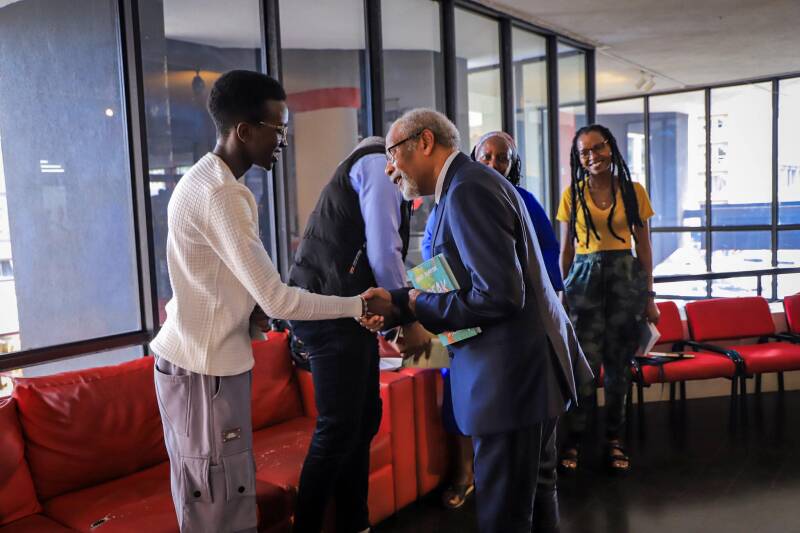
Emmanuel Marete greets Professor Bakari. Courtesy of Jerusha Kananu Marete.
In the past year, you have been studying Spanish. How is your progress in learning this language going?
I love my Spanish class so much. It is a very interesting language and easy for me to learn. Although I am not yet fluent, I would say I have made notable progress: I went from knowing nothing to being able to hold a small conversation in the language.
On June 28, 2025, at age 14, you launched your first book alongside your mother, the brilliant poet Jerusha Kananu Marete, Marry Me a Cowife. What did this double launch mean to you?
The dual launch of my book Dawn to Dust: Echoes of a Wounded Soul and my mother’s Marry Me a Co-wife meant an official initiation into the world of poetry and literature for me. It was an initiation I had long dreamed of, which led to the writing, editing, and publishing of my book, so I was ecstatic to show my work to the world. I was, and still am, extremely honored to have the privilege of sharing the stage with my mom, the person who inspired me to begin my poetic journey in the first place.
What themes does your poetic work explore?
My poetry mainly explores themes of mental health, depression, and social exclusion. I write poetry in the hope of giving voice to the voiceless and raising awareness about mental health.
How old were you when you wrote the poems selected for Dawn to Dust (Mystery Publishers Limited, 2025)?
The poems published in my book were written over a span of two years, with the oldest written when I was 12. However, I did a lot of editing, refinement, and even rewriting before submitting my initial manuscript to my publisher.
In the synopsis of Dawn to Dust, the publisher describes your book as “a raw and moving collection of poems that delve into the depths of human struggle and resilience.” How do you explain that someone so young can write about these topics with such depth?
From a very young age, I have always been a keen observer. I was always attentive to changes in emotions, expressions, and pauses. Also, I am empathetic, and my friends—both older and younger—often came to me for advice or simply to talk about what they were going through. Most of the themes in my book come from those observations and conversations. I have always believed in the power of voice, and my book was my way of speaking for those who felt they could not speak for themselves.

From left to right: Kamanu M'tuamwari, Emmanuel Marete Kimathi, Jerusha Kananu Marete, Kimathi Miriti (Jerusha Kananu’s husband), and Mawira M'tuamwari, during a book signing event in 2024. Courtesy of Jerusha
You grew up in a home of art and numbers: your mother is a multifaceted artist, you have a poet aunt, and your father is a renowned economist. What is a typical day like for you in this privileged environment?
I like to think of my family internally as a “family of polymaths” because I am blessed to have close relatives in many varied fields: law, engineering, medicine, neuroscience, cybersecurity, education, banking, economics, finance, insurance, politics, business, etc. As a result, I have had the opportunity to engage in many enlightening conversations that have shaped the way I reason, speak, and view the world. I am most grateful for the accessibility to books that this situation offers. I do not remember a single day when I lacked a book to read—whether it was my mother’s poetry collections, my aunt’s finance books, or even work documents broken down for me. Reading has always been synonymous with breathing in my life.
This privileged environment has properly nurtured my curiosity and encouraged me to ask more questions, research more, and most importantly, never be ashamed to ask or express an opinion—that is my greatest strength.
What comments have you heard about your poetry from your classmates?
My classmates and friends have been very supportive in all the ways that matter. They have always encouraged and motivated me to keep flying high. They have praised my poetry, with some saying it spoke to them and gave them the courage to open up about their emotions.
In this digital era full of distractions, meeting a 15-year-old with a published book who speaks three languages fluently is not common; it is almost a miracle. How have you managed not to be affected by the global digital virus that affects most teenagers?
I would not say I have tried to avoid social media or the internet. In fact, the internet has proven to be one of the most influential tools in my learning and development. However, I have learned to use it as a resource rather than a distraction. I would say that to avoid the “digital virus,” one must define their goals, create a roadmap toward those goals, and build systems that hold them accountable. It is also important to embrace your flaws and recognize that mistakes are inevitable, as that is the only way we grow and ensure that our mistakes do not become failure.
I have read that, besides poetry, you have a passion for mathematics, psychology, engineering, and systems thinking. What profession do you plan to study?
Professionally, I plan to study neuroscience, finance, and software engineering.
Have you thought about publishing a trilingual poetry anthology?
Yes. The idea of publishing a trilingual anthology is something I am considering for the future. I believe it would be a great way to reach a wider audience and connect better with my global readers.
Do you consider poetry a means of expanding conversations, and why?
For me, poetry has been an emotional outlet and I believe it is a beautiful way to articulate your thoughts. Often, when I am confused, I turn to poetry to organize my ideas and process my emotions. I believe this philosophy can apply to almost everyone: reading and writing poetry is a great way to expand conversations because it expresses our thoughts, emotions, and frustrations in a clear and structured way.
What do you consider the essential virtues for restoration and sustainability that humanity needs to achieve global unity?
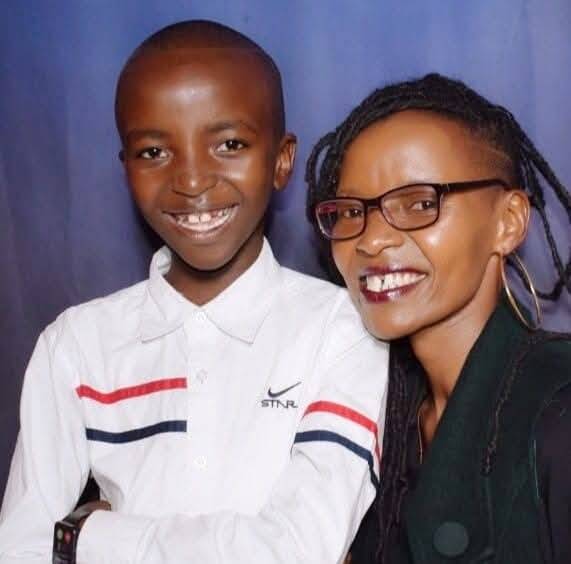
Emmanuel Marete Kimathi is the son of the renowned Kenyan poet Jerusha Kananu Marete. In this photo of mother and son, Emmanuel was 10 years old. Courtesy of Jerusha Kananu Marete.
Communication and empathy are the values I find most crucial for achieving global unity. When we can effectively communicate our needs while also understanding the limitations of others, we can reach compromises and solutions that benefit everyone.
How has the cultural and climatic change been since you moved from Kenya to the United States?
Moving to the United States has been a very enlightening experience for me. At first, it was difficult: new school, new people, new systems. But I chose to take it as an adventure. It was the first time I truly had to figure things out on my own without the close and timely intervention of my family and close friends. In Kenya, I was taught independence and self-sufficiency—after moving here, I lived it.
The climate change was more gradual, as I moved to the United States toward the end of summer and the weather was very similar to home at that time. Winter brought its challenges: snow, strong winds, and freezing weather. It was harder to adapt to winter, but I am glad I had my parents and friends to help me navigate it.
Add comment
Comments
Congratulations Emmanuel 👏. We are so proud of you . Thanks so much Carlos for amplifying the voice of the young author.