

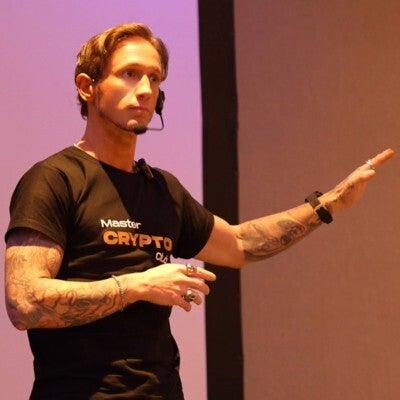
The man who teaches how to fish Bitcoin in an ocean of influencers selling dead fish. On YouTube, with the flag of El Salvador in the background, a man speaks of “social contagion” and “human stupidity.” It is not the typical hyperbolic thumbnail with Lambos and diamonds. Alejandro Egea, the Argentine systems analyst who defines himself as a “normal guy,” has built a community not around the promise of making money, but around the imperative of surviving with one’s sanity intact in the great global financial scam. While the crypto ecosystem fills with “influencers” promoting projects that later collapse like Libra, Egea repeats like a mantra: “I don’t sell smoke.” His proposal is more philosophical than financial: Bitcoin is not for buying a yacht, it is for buying your freedom. Interviewing him is a way of testing that thesis against his own warnings about greed, fear, and human nature.
1—You don’t speak of “investment,” but of a “store of value.” You don’t speak of “trading,” but of “long-term saving.” This conceptual framework is your first line of defense against what is described as the “social contagion” of scams. Do you believe your greatest battle is not against the traditional financial system, but against the psychological biases of your own followers: FOMO, impatience, and the search for shortcuts?
I believe the crypto sector never really considered banks or private institutions as enemies; although the media attacks by major powers in 2018 and 2019 were very serious, cryptocurrencies came to stay, and it was only a matter of time before this new decentralized market was assimilated as a powerful financial tool to solve problems in the traditional market. Even in my country (Argentina), where adoption is undoubtedly massive, there is still strong aggression against those of us who work in this field; mainly from banks, whose archaic model full of difficulties for users pushes Argentinians to choose the best option, which we already know.
Our goal as a personalized service is to understand the client, their needs, objectives, and concerns, to work by implementing well-defined tools and strategies and find what everyone is generally looking for: peace of mind and security.
Of course, nothing is 100% safe in this sector or any other; in fact, from 2008 (the biggest market crash of the 21st century) to today, with pandemics, post-pandemics, tariff imbalances, and never-ending wars, panic is often generated where people don’t know what to do with their money and centralization does not help at all.
So we aim to reduce that psychological uncertainty through four pillars:
• Research
• Planning
• Risk management
• 1-to-1 follow-up
Our biggest war, so to speak, is against the “smoke sellers,” as we say in my country: those who, without knowledge or real experience, sell you anything just to take your money and live off you. We show with real results how you can invest in cryptocurrencies, but clearly it is not magic and does not happen overnight.
2—By educating in this way, are you trying to create an “immune system” in your audience specifically against projects like Libra? Do you consider that each person who truly understands sovereignty becomes an antibody that stops the spread of mass scams?
Definitely: if you have a clear vision of how to research and identify projects, you would not enter memecoins or so-called “gems,” among other things.
Whenever risk, diversification, portfolio creation, and rotation are understood, as well as increasing units through passive income via audited DeFi protocols with real coverage, things like Libra and others should not affect anyone.
Although there is a clear reality: in the crypto world there is a big difference between scams—for example pyramid schemes (because they mutate to go unnoticed) or phantom cryptocurrencies that never existed but are sold outside the market on shady websites—and other very different cases such as projects that fail due to lack of support, lack of a solid community, or many other reasons.
Sometimes memecoins are on a very thin line between good and bad; although they are not prohibited or illegal by nature, they can be manipulated to deceive (like other narratives). In the case of Libra specifically, I cannot say President Milei is responsible for what happened, but his former advisors are, who knew exactly what was going on.
I clarify that those of us who have been in this field for more than 10 years, like myself, have fallen into this kind of thing more than once due to lack of knowledge or guidance; perhaps that is why what we do today is so important.
3—You are blunt: “I don’t have a single cent in any other cryptocurrency.” That is your personal ethical line, clear and public. But when you see other content creators on social media promoting assets you know are of dubious quality, do you feel the responsibility to call out the scam openly, or do you believe, as you usually say, that “everyone is responsible for their own risk” and your role is limited to not being part of the problem?
We can return to the Libra case specifically, which we followed very closely (I clarify that none of our clients bought that coin), but we did investigate it in depth.
If I use it as an example, I can say that everyone who invested in Libra was fully aware of the risk they were taking, unless they were deceived by a third party; buying that memecoin required steps within the DeFi ecosystem that a person without knowledge could hardly execute on their own, meaning it was not like going to the store to buy chocolate.
As a company, we do not attack or mention anyone directly (personally, sometimes I slip because I am very impulsive). This is because we are simply an educational and advisory company, nothing more and nothing less. We do not have jurisdiction nor are we legally authorized to accuse anyone of anything, and I believe influencers who do so are mistaken. In fact, I think several influencers who dedicate themselves purely to attacking others do so out of ego or for personal gain in views or money.
The reality is that there are scams on the internet all the time; in fact, today META charged me approximately 200 dollars improperly, and that happens with large companies, small companies, and individuals as well. But those so-called “hero” influencers do not do it out of love for people but out of ego and money; they choose whom to attack, meaning they can defame whoever they want, whether guilty or not.
I believe social media gives people too much power and it is difficult to identify who is good or bad. The best we can do is lead by example and be who we are; then people will decide. We do not defame anyone.
4—Articles show that Libra victims were ordinary people, many without knowledge. You insist that people “do not read,” “do not research.” Beyond individual responsibility, is there not a systemic failure of financial education that makes the crypto ecosystem a fertile ground for scammers? What responsibility do states have in this lack of basic education that you are trying to replace?
Personally, I do not consider that the people who lost money in Libra (in this specific case) were completely ignorant; to buy that cryptocurrency you needed to know DeFi to the point of knowing how to swap two tokens and where to do it.
I do consider that training is very necessary, both in knowledge and experience, to make decisions and move freely within any decentralized tool that operates with blockchain technology, which, I regret to say, few people (at least in Latin America) truly master.
Moreover, a company that provides a personalized 1-to-1 service where we guide you step by step, like Master Crypto Club, is highly valued.
I believe that everywhere in the world large-scale technological training (and also emotional and psychological education) should be provided, because the educational system is out of context with the reality we live in this century; we are no longer in the 20th century.
But even worse is being prevented from giving training or consulting, whether due to government reasons or any other kind (in Argentina we do not have issues with this).
A clear example of an aberration is META (formerly Facebook), which pressures us by blocking accounts, charging fines, restricting communication, and even taking harsher measures that not only have economic consequences but also emotional and psychological ones; defending and working with cryptocurrencies already carries significant weight as it is, and on top of that we are pressured with such aggression.
5—You have said that one can become a millionaire and live only from Bitcoin. It is the “happy ending” many pursue. But imagine you achieve it, that your entire community reaches that economic sovereignty. At that point, what is the next purpose? Does financial freedom become a means to a greater end, or does it reveal a new layer of existential emptiness that money cannot fill?
Bitcoin is an asset and many people have managed to take advantage of it to obtain significant benefits, but it is always a small percentage that achieves extraordinary results.
I believe the most coherent approach is to operate in a healthy way and build a sustainable crypto asset in the long term, later thinking of a retirement fund or a capital reserve that allows a certain financial freedom. From my point of view, depending solely on one asset is complicated, although it could be achieved if conditions are favorable.
When we talk about financial freedom, we are talking about financial education; if anything teaches this, it is not to depend on a single income, but to create different assets and grow as a professional in any field, which makes life more interesting.
I also believe that to achieve all this you must first rely on yourself: be healthy in every aspect, because everything starts within.
6—You come from the world of systems analysis, pure logic, and code. However, to explain Bitcoin you constantly use real-life analogies: the stationary bicycle scam, “social contagion,” store of value refuges. Is this the great challenge: translating a technological and abstract concept into a human, emotional, and understandable language? Do you consider yourself, at heart, more of a cultural translator than a financial analyst?
I am not a financial analyst, although I hope to be soon; I am about to reach that goal. It is true that in logic I have great ability to interpret situations, contexts, and moments.
I am trained in Europe as a DeFi expert, among other things I have studied throughout my 36 years, but I will always believe that my greatest strength comes from my work team and my clients, as they are the soul of Master Crypto Club.
7—Your strategy is one of strict patience: buy, hold, and wait, ignoring the noise. But this is deeply countercultural in an era of instant gratification. How do you psychologically handle the “loneliness” of your own strategy when the whole market screams the opposite? And how do you explain to someone who needs to pay their bills today that the real potential lies in a 5- or 10-year horizon?
There are different investor profiles in the market; it could be said that I have a risk profile because I do not only HODL, but also use combined tools and strategies to increase my portfolio units, managing rotation or exiting in profits to re-enter. Although it does not always work perfectly, because no one has a crystal ball and in such a volatile market the luck factor directly or indirectly plays a role; tomorrow someone could say cryptocurrencies are no longer useful and everything could crash. We already saw this in 2022 with a domino effect of different black swans.
I always thought the most important thing is not to be afraid of money and to focus on moving forward in life, and having been in this field for 11 years, I can tell you it is all a matter of patience.
8—If your educational work succeeds, you will form a generation of sovereign, critical, and independent individuals. Do you ever worry that this success could create a community of “Egeists” who follow your words dogmatically, repeating slogans without the individual verification process you preach? How do you ensure your legacy is seeds of critical thinking and not an army of followers?
Basically, I provide a service for people like me; no one who follows me or is my client will remain silent, I would not do so. And honestly, I expect that from them because it is the only way to improve and for our service to remain one of the best.
Perhaps that is something that sets me apart, I am not entirely sure, but entering our service you become sovereign, as we give you enough experience and knowledge, plus a whole team that researches, plans, and executes to show you the path.
Alejandro Egea is not a guru. He is a realist. As we say goodbye, there remains the feeling of having spoken with an architect of mental bunkers for a collapse that he sees as inevitable. His value is not in predicting the price of Bitcoin, but in offering the conceptual tools to navigate chaos, both in the market and in our own psychology. This conversation does not end with a buy recommendation. It ends with an uncomfortable question he throws back at us: Are you willing to take full responsibility for your financial life, or do you prefer to remain a child in a world of adults who sell you shiny illusions? In the era of social contagion, sovereignty is not an investment option. It is, as Egea shows, the last refuge of dignity.
Add comment
Comments